
Turn Daily Moments into Emotional and Physical Intimacy
Deep emotional connection and a satisfying sex life don’t come back by accident. They return when couples create intentional time, show genuine interest, and choose daily actions that build an intimate connection on purpose.
Shift out of autopilot and into science-backed ways to feel closer every day. The more consistent the habit of connection, the less reactive the relationship becomes. Research shows successful couples balance negative interactions with 20X more positive ones. The SYNC Tool makes that doable—even on hard days.
Why Closeness Fades—Even in Loving Relationships
Most couples don’t wake up one day disconnected. Closeness fades because life pulls your focus everywhere else. Between work, parenting, stress, and constant stimulation… intimacy quietly moves to the background. Conversations become transactional. Physical touch becomes functional. Eye contact gets replaced by screens.
And suddenly, the romantic relationship that once felt alive starts to feel distant. When couples stop intentionally nurturing the relationship, emotional closeness erodes—and desire often follows.
Intimacy doesn’t just happen automatically after the honeymoon phase. It happens when you take meaningful action to connect — especially when you don’t feel like it.
How Busy Couples Can Increase Intimacy
Intimate connection doesn’t require weekend getaways or dramatic gestures. It’s built in just a few intentional minutes a day… a hand on the back, real eye contact, a deeper conversation before bed, presence instead of multitasking. These meaningful moments are what strengthen romantic relationships and keep physical and emotional intimacy alive over time.
Build a bond that brings out the best in both of you with simple, high-impact habits that fit into even the busiest days. These micro-moments train your nervous system to stay open—so when stress hits, connection is already there. That’s where SYNC comes in.
Hello and Goodbye Matter More Than You Think
One of the fastest ways to improve emotional closeness and physical intimacy in a relationship isn’t deeper conversations or date nights.
It’s better greetings and reunions.
According to relationship researchers John Gottman and Julie Gottman, how couples say hello and goodbye—especially at the beginning and end of the day—has an outsized impact on emotional connection, trust, and long-term relationship satisfaction.
This isn’t just behavioral—it’s attachment at its most primal.
From infancy, saying goodbye and being warmly reunited is how humans wire safety, bonding, and emotional security. Babies and toddlers check: Are you still there? Do I matter? Will you come back?
Romantic partners ask the same questions—just more quietly.
When greetings disappear into rushed mornings, silent exits, phones, or collapsing into bed without eye contact, touch, or connection, the nervous system registers distance. Emotional closeness weakens. Physical intimacy disappears.
That’s why relationships slide downhill fast when partners stop intentionally greeting and reconnecting.
The good news?
This is also why restoring warm hellos and meaningful reunions is one of the most leveraged ways to bring the spark back.
A hug that lasts a few seconds.
Eye contact when you walk through the door.
A real “I’m glad to see you.”
A moment of cuddling before sleep.
These small rituals calm the nervous system, reinforce attachment, and remind both partners: We’re still here. We still choose each other.
That’s exactly why Salutations is the first habit in SYNC—and why it works so quickly.
Deepen Intimacy in Minutes A Day with SYNC
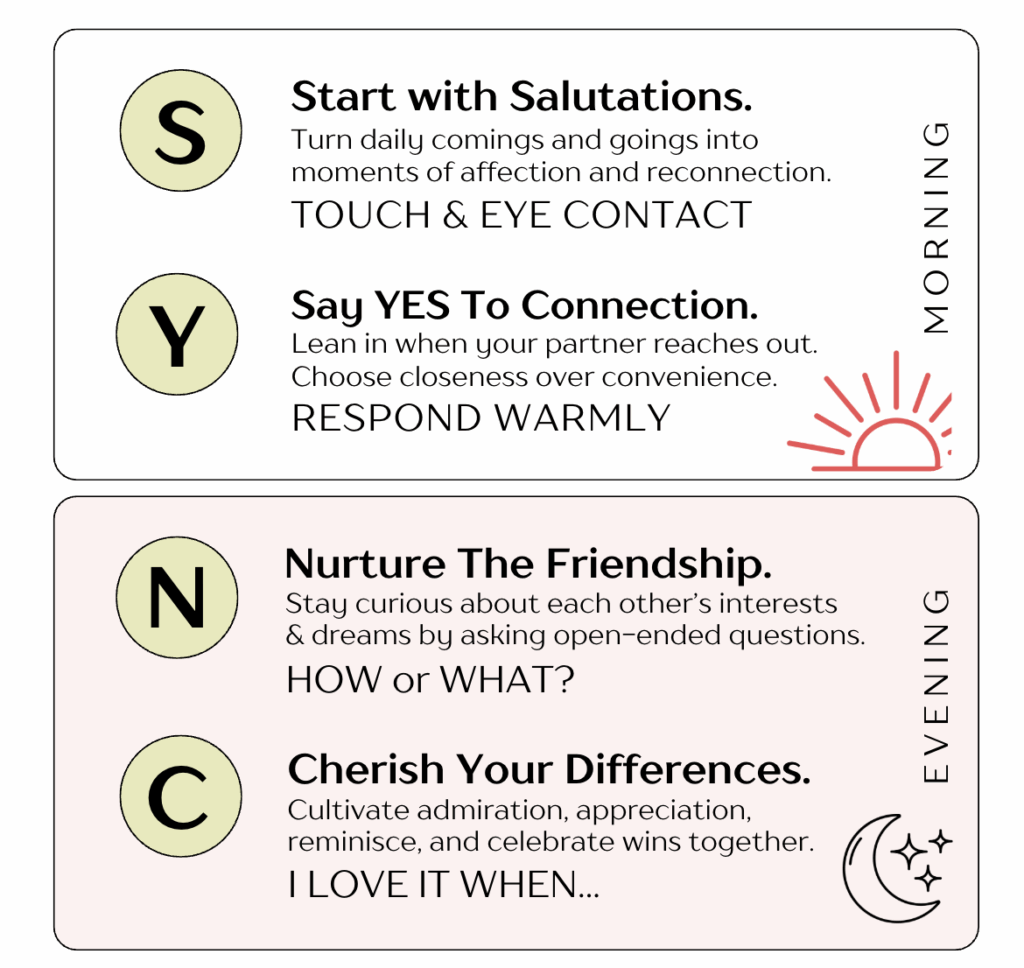
The SYNC Tool → Daily Habits That Strengthen Emotional Connection
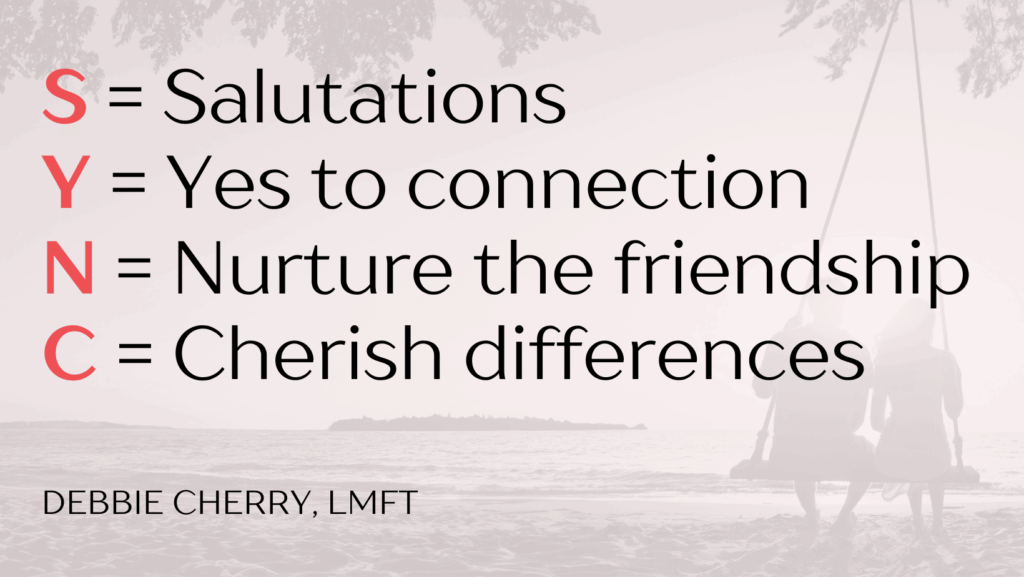
SYNC = Salutations • Yes • Nurture • Cherish
SYNC is a simple, high-impact habit system designed to strengthen your bond so you stay connected, even when life is full and bandwidth is small.
You don’t need more time.
You need better moments.
S = Salutations and reunions
Start and end the day with affection… a kiss goodbye, a warm hello, a hand squeeze before sleep.
These moments tell your nervous system: You matter. I see you.
Y = Yes to connection
Turn toward the little moments that matter… yes to listening, yes to responding, yes with a smile.
Becoming better partners unlocks desire.
N = Nurture the Friendship
Ask open-ended questions to learn new things. Intimacy grows when curiosity stays alive.
This invites emotion—not logistics.
C = Cherish your differences
Celebrate each other’s wins. When partners feel valued, they feel closer.
Appreciation keeps desire alive.
Elevate your daily interactions with habits that turn routines into moments of real connection.
📸 Snap a screenshot of the SYNC Tool to use when you need it most.
A Simple, Research-Backed Way to Build Intimacy
You don’t stop loving each other.
You stop turning toward each other.
Most couples don’t lose closeness through big betrayals.
They lose it through missed moments.
A comment that goes unanswered.
A touch that doesn’t happen.
A joke that goes unnoticed.
Over time, partners stop reaching for each other.
These moments are what the Gottmans call bids for connection, and turning toward them consistently is one of the strongest predictors of lasting relationships. Couples who turn toward each other’s bids for connection about 86% of the time build strong, lasting relationships. Each response deposits goodwill into your emotional bank account.
What Turning Toward (And Saying Yes) Looks Like
- Smiling when you pass each other in the hallway
- Making eye contact instead of looking at your phone
- Touching your partner’s arm or shoulder as you walk by
- Leaning in when your partner sits next to you
- Pausing what you’re doing to listen, even for 30 seconds
- Asking a follow-up question when your partner shares something
- Showing interest in a hobby you don’t personally care about
- Saying yes to a short walk, even when you’re tired
- Matching their energy instead of shutting it down
- Letting them explain something you don’t care about
- Joining them for a few minutes in what they’re doing
These micro-moments tell the nervous system:
We’re on the same team. We’re still connected.
That’s why Yes is a core SYNC habit—and why it works so fast.
Intimacy isn’t created in grand gestures.
It’s built through daily habits.
Nurture the Friendship to Restore Intimacy
In the beginning, friendship came easily. You were curious. You stayed up late talking. You wanted to know how your partner thought, what excited them, what bored them, what they dreamed about. You listened to learn—not to fix, correct, or react.
You were genuinely interested… even when the topic wasn’t that interesting.
Over time, stress and resentment change the tone. Walls go up. Curiosity shuts down. Conversations become logistical. Partners start feeling more like roommates than romantic partners, and emotional intimacy quietly erodes.
According to John Gottman, friendship is the foundation of lasting romantic relationships. When partners stop nurturing curiosity, fondness, and understanding, both emotional and physical intimacy suffer.
You just need five to ten intentional minutes.
One open-ended question a day—asked with real presence—can dramatically increase emotional closeness and rekindle intimacy.
The key is listening to learn, not to respond.
Try open-ended questions (What or How) like:
- “What’s been on your mind lately that we haven’t talked about?”
- “What’s something you’re looking forward to right now?”
- “What feels heavy for you these days?”
- “What’s something you’re curious about or excited by lately?”
- “If things were easier a year from now, what would be different for us?”
That small daily habit rebuilds emotional closeness—and intimacy comes back with it.
That’s why Nurture is a core SYNC habit.
Cherish Your Differences to Spark Desire
The very qualities that pulled you together in the beginning are often the same ones that start to push you apart later.
At first, your differences felt magnetic.
Spontaneity was playful.
Grounded determination was sexy.
Humor softened the edges.
Stability felt safe and exciting.
Over time, those same traits can get distorted by stress, resentment, and survival mode.
“In the moment” turns into irresponsible.
Driven and focused turns into nagging or no fun.
Laid-back becomes uncaring.
Organized becomes controlling.
Nothing actually changed about who you are.
What changed is the lens you’re looking through.
Your brain is wired to scan for threat, especially in close relationships. That means if you don’t intentionally overcorrect, your attention will default to what’s wrong instead of what’s beautiful.
Cherishing your differences is how you reverse that drift.
When you actively notice, name, and appreciate each other’s strengths, something powerful happens:
resentment softens, emotional safety returns, and attraction reignites.
Differences stop feeling like obstacles and start feeling like assets again.
That shared energy—your synergy—is what creates intimacy, spark, and desire.
How to Cherish Your Differences (Practically)
- Say appreciation out loud. Don’t assume they know. Your nervous system needs to hear it—and so does theirs.
- Celebrate wins, even when you’re annoyed about something else that happened that day.
- Join them in their excitement. Their hobbies, interests, or passions—even if they’re not yours.
- Show fondness and admiration. Desire grows where admiration lives.
- Reminisce about moments that highlight your strengths together—especially funny or meaningful ones.
Simple Phrases That Rebuild Attraction
Get in the habit of saying things like:
- “I love it when you…”
- “Thank you for…”
Examples:
- “I love it when you make me tea in the morning without me asking.”
- “I love it when you bring humor when things feel tense.”
- “I love how grounded you are—it makes me feel like we can handle anything.”
- “I love that you take time for yourself. It’s actually really sexy when you come back recharged.”
- “Thank you for being strong today when things were hard.”
- “Thank you for handling the logistics for that event—it took so much off my plate.”
- “Thank you for your creativity. It brings lightness to our life.”
- “I love how thoughtful you are with the kids—it reminds me why I chose you.”
Cherishing your differences isn’t about ignoring problems.
It’s about remembering why you chose each other in the first place—and letting those strengths work for the relationship instead of against it.
That’s where intimacy comes back.
That’s where the spark lives.
That’s where desire grows.
That’s why Cherish is a core SYNC habit.
Build the Relationship You Both Want
When you show up consistently, closeness becomes your default.
That’s what SYNC is for: an easy, research-informed way to build intimacy daily in minutes — even when life is full.
Connection takes practice. SYNC makes it simple.
keep connecting,
Debbie Cherry, LMFT
WANT TO FEEL CLOSER AGAIN?
💝 Grab the free Connected Communication Toolkit with simple, science-backed habits to deepen emotional and physical intimacy in everyday moments.
📅 Book a free consultation or session to reconnect, rebuild closeness, and bring back the spark—without pressure or blame.
💬 FAQs About Increasing Physical Intimacy
- What does intimacy in a relationship really mean?
Intimacy in a relationship includes emotional connection, physical intimacy, sexual intimacy, physical affection, and feeling understood. It grows through self-disclosure, sharing deepest thoughts, physical contact, and spending quality one-on-one time together. - How can we increase physical intimacy?
Emotional and physical intimacy happen through small gestures, physical closeness, quality time, eye contact, and communicating openly—even when life, family members, friends, current events, and other commitments compete for attention. - How do couples build a lasting, fulfilling relationship?
Lasting relationships develop when partners prioritize intimacy in a relationship through personal communication, vulnerability, spending time together, physical affection, and staying connected at a deeper level despite a busy world. - Why do emotional and physical intimacy fade over time?
Emotional and physical intimacy often fade when couples stop spending quality one-on-one time, reduce physical contact and affection, and get pulled apart by stress, family members, other commitments, and the demands of daily life. Small gestures and intentional closeness help intimacy return. - What small gestures help build intimacy and closeness?
Small gestures like physical contact, affection, sharing a favorite childhood memory, quality time, and intentional one-on-one time help couples develop intimacy, strengthen physical closeness, and feel connected to loved ones over time.
📚 Building Intimacy References & Resources
Improve Your Relationship by Paying Attention to “Bids for Connection” (Gottman Institute)
This article explains the foundational Gottman research showing how partners influence emotional closeness, passion, and physical intimacy by responding to each other’s bids for connection — the small invitation moments that say “Do you see me? Do I matter?” It also cites the famous finding that happy couples turn toward each other’s bids about 86% of the time, and that daily attention to these moments creates trust, deeper connection, and greater satisfaction in the relationship.
Interview with Guy Finley about Relationship Magic
In this podcast interview, Finley discusses how relationships can be transformational and how differences and reactions are opportunities for growth rather than problems to fix. In his book, Relationship Magic: Waking Up Together explains how romantic partnerships serve as mirrors that reveal both comfort and conflict — and that by staying present with difference and reaction, couples can deepen emotional, spiritual, and intellectual intimacy and transform relational tension into relationship magic.
The Mystery of Desire in Long-Term Relationships” – Esther Perel (TED Talk)
Psychotherapist Esther Perel explains that while love seeks closeness and safety, desire thrives on difference, polarity, and otherness. When partners stop seeing each other as separate, intriguing people — and instead see only roles or frustrations — attraction fades. Relearning how to cherish your differences restores emotional, physical, and even spiritual intimacy by bringing admiration and curiosity back into the relationship.