Conflict Isn’t the Problem. Survival Mode Is.
You love your partner, but small disagreements can spiral quickly. Before you know it, you’re both defensive and alone.
When we feel triggered in a relationship, we shift from connection to protection.
In fight-or-flight mode, the brain takes shortcuts to conserve energy. These automatic defenses flatten nuance, fill in intent, and limit access to empathy.
You stop feeling like partners and start reacting like opponents.
That’s why small disagreements become big fights… and why they hurt so much.
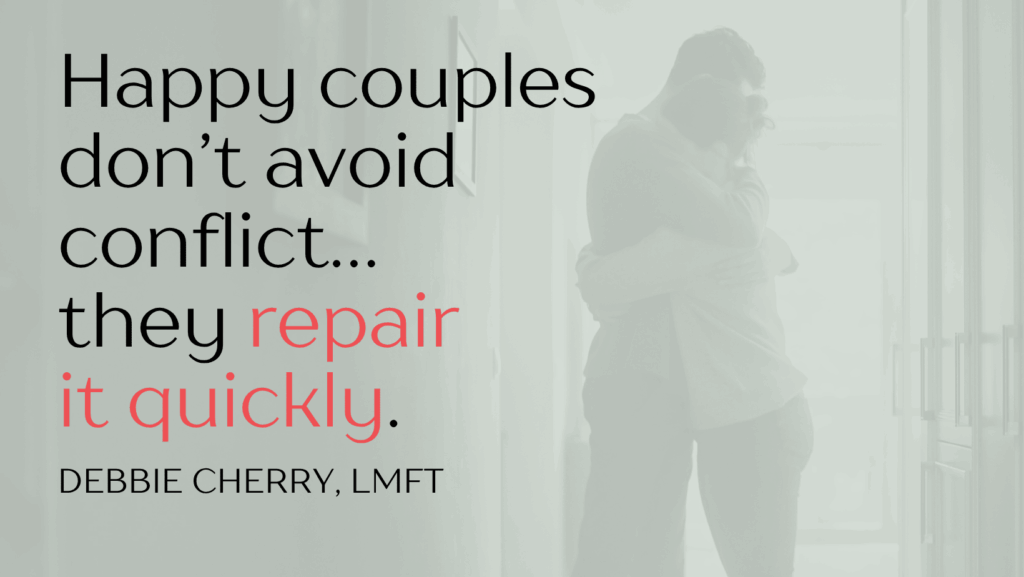
Healthy relationships aren’t defined by how little couples fight.
They’re defined by how quickly partners can come back to safety when things go sideways.
The SAFE tool gives you a way to do exactly that.
Why Couples Get Stuck in The Disconnection Spiral
Human attachment systems evolved for survival.
When we were infants, losing connection meant danger.
That wiring stays with us.
So when your partner seems critical, distant, dismissive, or unavailable, your nervous system reacts fast — often before you can think.
In survival mode:
- Your capacity narrows
- Empathy drops
- Old stories activate
- Everything feels personal
That’s why arguments feel so intense in the moment… and so painful afterward.
The SAFE Tool Interrupts Fight-or-Flight
The SAFE tool works because it doesn’t argue with logic — it calms the nervous system first, then gently corrects the brain’s biased shortcuts.
After working with thousands of couples, I’ve seen these four evidence-based steps transform reactive fights into emotional repair.
Think of it as the “Stop, Drop, and Roll” for relationships.
The SAFE tool helps you move from protection back into connection in minutes instead of hours.
Repair Quickly with the 4 SAFE Steps
Conflict isn’t the problem. Disconnection is.
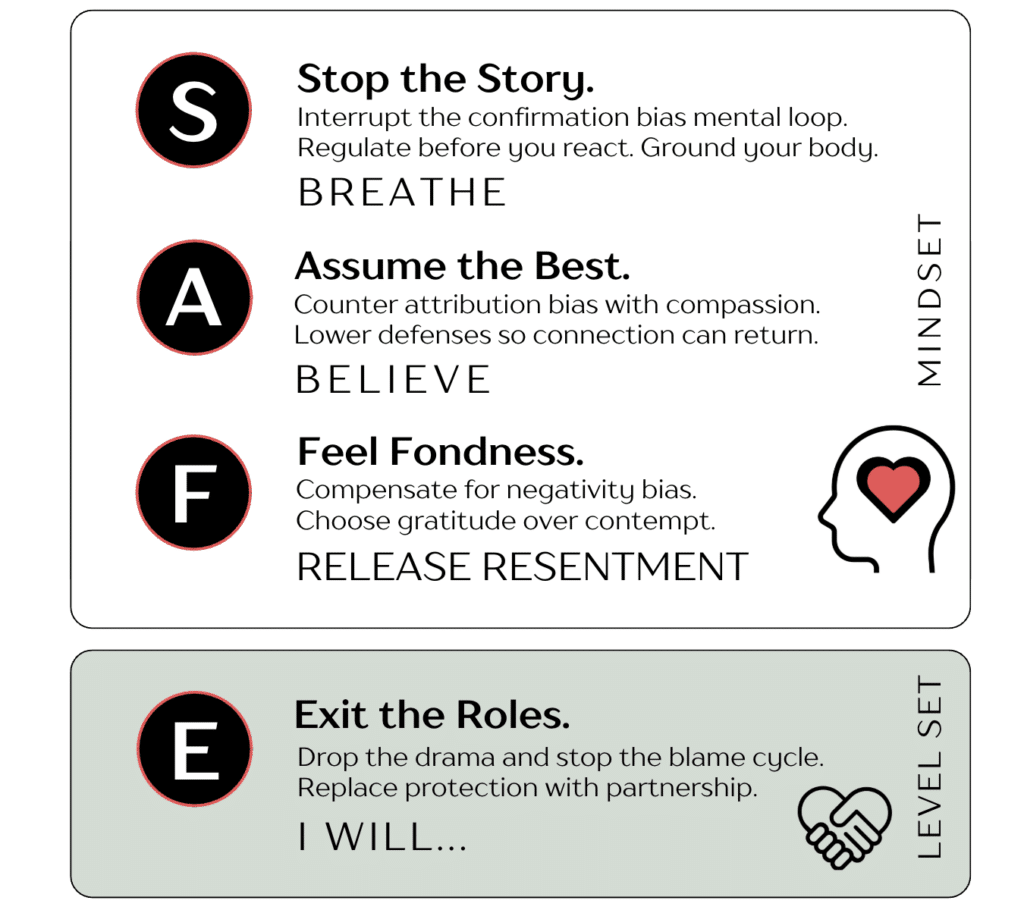
The SAFE Tool gives you a simple four-step process to interrupt destructive patterns in real time—so you can reconnect instead of react.
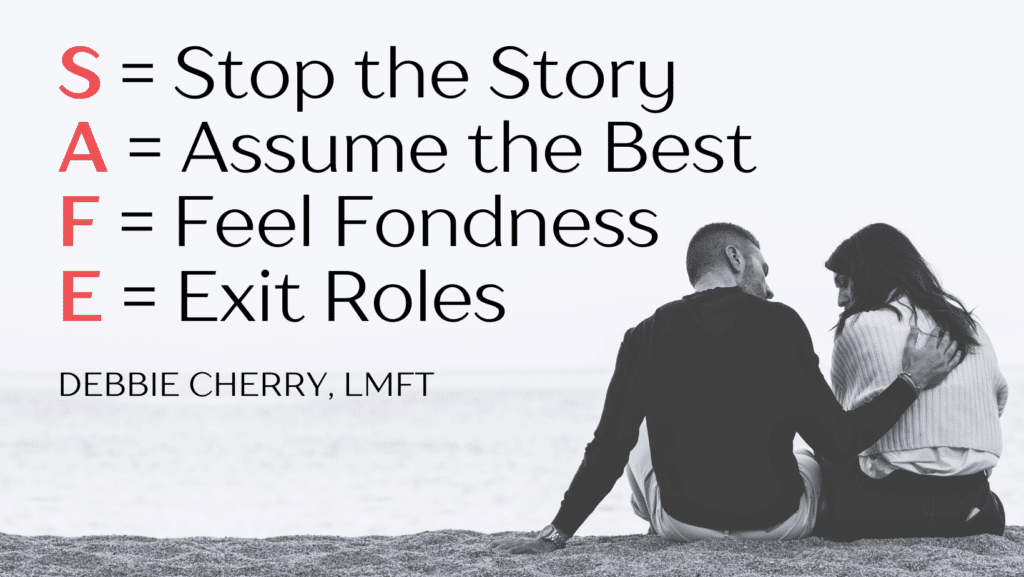
SAFE = Stop the Story • Assume the Best • Feel Fondness • Exit the roles
STEP # 1 — S = Stop the Story
When you’re triggered, your mind starts writing a story:
“Here we go again.” “They don’t care.” “I always get blamed.”
Stop.
Breathe.
Interrupt the spiral.
Regulation starts with slowing your body, so old beliefs don’t hijack your future.
STEP # 2 — A = Assume the Best
Under stress, we assume the worst about the people we love.
This step reminds your nervous system:
“My partner is not my enemy.”
You don’t have to agree — just remember that your partner isn’t trying to hurt you, so connection becomes possible again.
STEP # 3 — F = Feel the Fondness
In survival mode, we stack the negative and ignore the positive.
Fondness widens the lens. Choose gratitude over contempt—the #1 predictor of divorce.
You are not pretending everything is fine. You’re reminding your brain that this person is more than this moment.
Appreciation is the antidote to resentment.
STEP # 4 — E = Exit the Roles
Exiting the roles means stepping out of ingrained defensive patterns pushing you farther apart.
It doesn’t need to be fancy.
It can be:
- “I will slow down.”
- “I will listen.”
- “I will try again.”
This step shifts the relationship from me vs. you to us vs. the problem.
When both partners take responsibility, repair happens quickly.
📸 Snap a screenshot of the SAFE Tool to use when you need it most.
The Key To Emotional Safety In Conflict Resolution
Conflict is inevitable. Disconnection doesn’t have to be.
Feeling connected isn’t a luxury — it’s a biological need.
Just as great leaders foster psychological safety at work, great partners cultivate it at home. When both people feel secure enough to take risks, share honestly, and make mistakes without fear of rejection, they can keep growing instead of guarding.
Trying to communicate while flooded is like trying to have a thoughtful conversation while on fire.
SAFE puts out the fire first.
Then, real connection can happen.
Repair, Not Resolution: The Real Goal of Healthy Relationships
Nearly 70% of relationship problems are perpetual, according to decades of research. Differences in personality, values, and history guarantee conflict — even in the happiest couples.
“Fights In Relationships Are a Losing Battle.”
What predicts success isn’t agreement. It’s repair.
Stable couples maintain roughly a 5-to-1 ratio of positive to negative interactions during conflict. Warmth, humor, and appreciation matter more than being right.
Every time you choose connection over protection, your brain rewires for trust, generosity, and love.
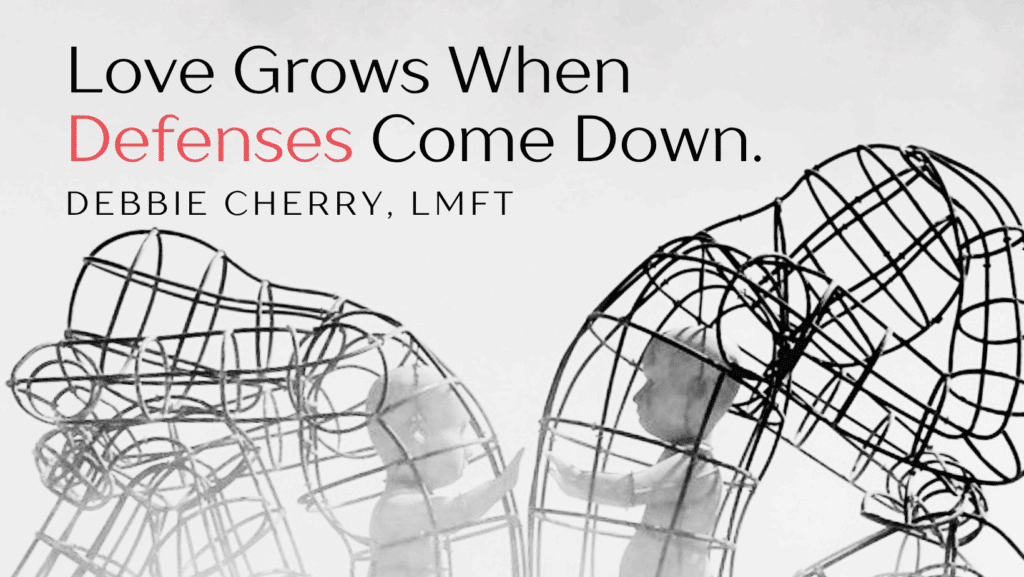
Don’t Let Defenses Stand Between You and Your Partner
Couples conflict is inevitable in intimate relationships.
How you handle it determines the outcome of your relationship.
Stop trying to resolve every issue.
Start focusing on how quickly you can return to connection.
Because love doesn’t grow from being right.
It grows from feeling safe.
Keep connecting,
Debbie Cherry, LMFT
WANT TO STOP RECURRING FIGHTS?
💝 Grab the free Connected Communication Toolkit filled with practical tips to help you talk, listen, and grow together.
📅 Book an appointment for a free consultation or a session to hit the reset button and resolve resentments for good.
Next Step ➡️ Learn What Habits Matter Most for Successful Relationships & Avoid Fights Before They Start with the SWOT Analysis Couples Activity.
💬 FAQs About Repairing Couples Conflict Fast
1. Why do we keep fighting even when we love each other?
Many relationship conflicts happen because of differences in personality, communication style, and partner’s actions—not lack of love. Every person brings old wounds, old ones from childhood or past relationships, that shape how they resolve conflict. John Gottman’s research found that even in first marriages, most conflicts are perpetual problems that can’t be fixed but can be softened through good communication, emotional intelligence, and empathy.
2. How do we stop small arguments from turning into big, heated fights?
When household chores, in-laws, or daily stress trigger a heated argument, pause and breathe. Notice your body language and tone—defensiveness fuels disconnection. Choose to assume good intentions and listen to your partner’s personality and perspective. Using tools like the SAFE method helps partners resolve conflicts faster and maintain a stronger, loving relationship.
3. What’s the fastest way to resolve conflict in a relationship?
The quickest path to resolving conflict is to focus on connection before correction. Stop, self-regulate, make eye contact, and express fondness before diving into complex issues. These conflict resolution strategies calm your nervous system so you can find solutions together and move from struggle to agreement, building a stronger relationship that lasts for life.
4. Why can’t we agree on anything lately?
Most couples disagree because they see differences as threats rather than opportunities for understanding. Conflict management means learning to resolve conflicts without demanding total agreement. Healthy communication skills, active listening, and perspective taking turn differences into insight, helping both partners feel safe and understood—even when dealing with complex issues or unmet partner’s dreams.
5. How can we communicate better during arguments?
Use I statements, real listening, and good communication habits like open body language and calm tone. Focus on understanding your partner’s behavior and other partner’s feelings rather than trying to win. This kind of healthy communication supports conflict resolution styles that create a safe space for empathy, teamwork, and repair—key ingredients of a healthy, loving relationship.
6. When should we seek professional help for ongoing relationship conflict?
If you repeat the same arguments, feel attacked, or can’t resolve conflict after a big argument, it’s time to seek professional couples therapy. A couples therapist trained in the Gottman Method, Imago Relationship Therapy, or Sound Relationship House approach can guide you through effective conflict resolution so you can rebuild trust, resolve complex issues, and grow a stronger, more resilient relationship.
7. What therapeutic approaches inform your conflict-resolution method?
My approach integrates several evidence-based models that all point to the same core truth: most conflict is a nervous-system event rooted in attachment needs — not a sign of incompatibility. When partners feel unsure, overwhelmed, or disconnected, the brain shifts into protection mode. Even small misunderstandings can trigger big reactions. Using PACT (Stan Tatkin), Emotionally Focused Therapy (Sue Johnson), the Gottman Method, and attachment-based neuroscience, I help couples understand what’s happening beneath the surface so they can calm reactivity, feel safer with each other, and communicate more effectively.
These are the primary approaches informing the SAFE method:
Attachment Theory (John Bowlby, Mary Ainsworth, Mary Main) and Attachment science shows that we are biologically wired to seek closeness, reassurance, and safety with our most important person.
When partners feel unheard or misunderstood, the brain interprets the moment as an attachment threat, which activates protest behaviors (pursue, criticize) or protection behaviors (withdraw, shut down). Attachment theory guides the emphasis on emotional safety, responsiveness, and secure connection throughout the SAFE tool.
EFT – Emotionally Focused Therapy (Dr. Sue Johnson) focuses on the negative cycle between partners—not the individual partners themselves.
It helps couples recognize how fear, insecurity, and unmet attachment needs drive reactivity.
EFT teaches partners to reach or each other with vulnerability instead of defense.
SAFE echoes EFT by helping partners slow the cycle, validate feelings, and reconnect before things escalate.
PACT – Psychobiological Approach to Couple Therapy (Dr. Stan Tatkin) integrates neuroscience, arousal regulation, and attachment theory to show how quickly the nervous system can shift into threat mode in relationships.
Key PACT concepts included in my work:
- micro-expressions and body cues
- moment-to-moment regulation
- partners as each other’s “external nervous system”
- the idea that “secure functioning couples protect each other first.”
The SAFE steps reflect these principles by helping partners regulate early, stay attuned, and move toward each other instead of into fight-or-flight.
Somatic & Mindfulness-Based Approaches (e.g., Gendlin, Kabat-Zinn):
Somatic awareness and mindfulness help couples calm physiological reactivity so they can think clearly and connect rather than defend.
The “Stop & Self-Regulate” step comes directly from these principles.
Gottman Method Research (John & Julie Gottman) and findings inform several parts of the SAFE tool, especially:
-
repair attempts
-
soft start-ups
-
the 5:1 positive-to-negative ratio
-
turning toward bids for connection
-
interrupting contempt, the #1 predictor of divorce
These research-backed behaviors reinforce the practical, quick-application nature of the SAFE method.
Additional Influences: My approach is also shaped by:
-
Imago Relationship Therapy (Harville Hendrix & Helen LaKelly Hunt) — focusing on childhood wounds and unmet needs that resurface in partnership
-
Internal Family Systems (Dr. Richard Schwartz) — understanding protective parts that activate during conflict
-
Interpersonal Neurobiology (Dr. Dan Siegel) — integrating mind, brain, and relationships
📚 Couples Conflict References & Resources
- Escaping the Drama Triangle: Strategies for Successful Relationships
This article explores the drama triangle—the repeating cycle of victim, rescuer, and persecutor—and how it undermines emotional safety and connection. It shows how one partner may carry more emotional weight in couples work and how avoiding conflict only delays healing to a later date. The piece reminds readers that feeling angry or encountering hurtful things is a natural part of healthy relationships, and that couples therapy can help partners step out of blame and into teamwork. - How to Create Emotional Safety in Your Relationship
This resource offers grounded, practical steps for cultivating safety and trust during conflict. It normalizes the fact that anger and defensiveness are a natural part of intimacy, while showing how self-regulation and empathy create healthy relationships. Ideal for partners doing couples work or simply learning to stay connected when emotions rise. - Gottman Relationship Research Overview
Decades of relationship research demonstrate that about 69 percent of relationship conflicts are perpetual—rooted in personality traits, underlying issues, and normal differences between partners. The findings affirm that conflict is a normal part of healthy relationships and emphasize the importance of not avoiding conflict or letting things linger. Instead, good communication and win-win solutions help couples move forward so they can grow stronger.
NEXT STEP ➡️ Avoid Fights Before They Start & See What Habits Matter Most for Successful Relationships with the SWOT Analysis Couples Activity.