What Needs to Happen Before You Can Move Forward
Relationship hurt can be small, like forgetting to put something on the shared calendar.
Or it can be big, like lying, betrayal, or years of infidelity.
The event matters. But often, what hurts most goes deeper than the actual thing someone did or didn’t do.
It’s the feeling of being alone in it.
It hurts when the person who is supposed to keep you in mind seems to forget about you completely.
It can be terrifying when the person you chose to stand beside you suddenly feels like they don’t have your back.
There can be a deep sense of dread when the person who usually knows you best doesn’t seem to understand you at all.
And it can feel incredibly lonely when the person you would normally turn to when you’re hurting is the same person who caused the hurt.
That is why relationship repair is about more than fixing what happened.
Sometimes the first thing that needs repair is the feeling that you are in this alone.
Relationship Hurt Can Be a Moment, a Pattern, or a Rupture
A relationship rupture is anything that disrupts your sense of trust, safety, or connection with your partner.
Sometimes it is one clear moment.
Sometimes the same hurt happens repeatedly.
Sometimes it is a whole period of the relationship that still feels unresolved.
The Partner Empathy Map can be used for any of these. The important part is choosing something that still carries emotional weight and trying to understand what that experience was actually like for your partner.
Relationship hurt is going to happen.
We miss things. We disappoint each other. We get defensive. Our needs compete. Our priorities do not always line up. We say something poorly. We pull away. We fail to show up in the way our partner hoped we would.
And sometimes the hurt is much more serious.
The goal of a strong relationship is not to somehow eliminate every painful experience.
It is to know how to come back toward each other when one happens.
Why Hurt Can Feel So Much Bigger Than the Event
Relationship pain often carries a message.
A forgotten task can feel like:
You don’t think about me.
A defensive response can feel like:
My feelings don’t matter to you.
Being left alone during a hard moment can feel like:
I can’t count on you when I really need you.
A betrayal can feel like:
The person I trusted most in the world was not protecting me or our relationship the way I believed they would.
This is part of why attachment injuries can feel so intense. The pain is not only about the event. It can threaten something much more basic: Do I matter to you? Can I trust you? Are you there for me? Am I safe with you?
When that sense of connection gets threatened, we can become much more reactive, defensive, absolute, or focused on danger.
And that makes perspective-taking much harder exactly when couples need it most.
The Loneliness Is the Problem You’re Actually Solving
Sometimes we try to solve the wrong problem first.
When something goes wrong, most of us start looking for solutions.
What happened?
Who did what?
How do we keep it from happening again?
Do we need a new rule?
A boundary?
A better agreement?
More honesty?
A change in behavior?
Those things can be essential.
But sometimes couples rush toward solutions while one person is still thinking:
You still don’t understand why this hurt me so much.
That person may explain it again.
Ask another question.
Bring up another detail.
Try another way of saying it.
From the outside, it can look like they are rehashing the past.
But sometimes they are still trying to get something important to land.
The goal is not to endlessly revisit what happened. It is to understand it well enough that the person who was hurt does not have to keep fighting to make the experience understood.
About 69% of relationship problems are perpetual, according to the Gottmans’ research. So if you keep thinking, “Why haven’t we fixed this yet?” you may be asking the wrong question. The better question is: How do we make room for two different experiences and still feel connected?
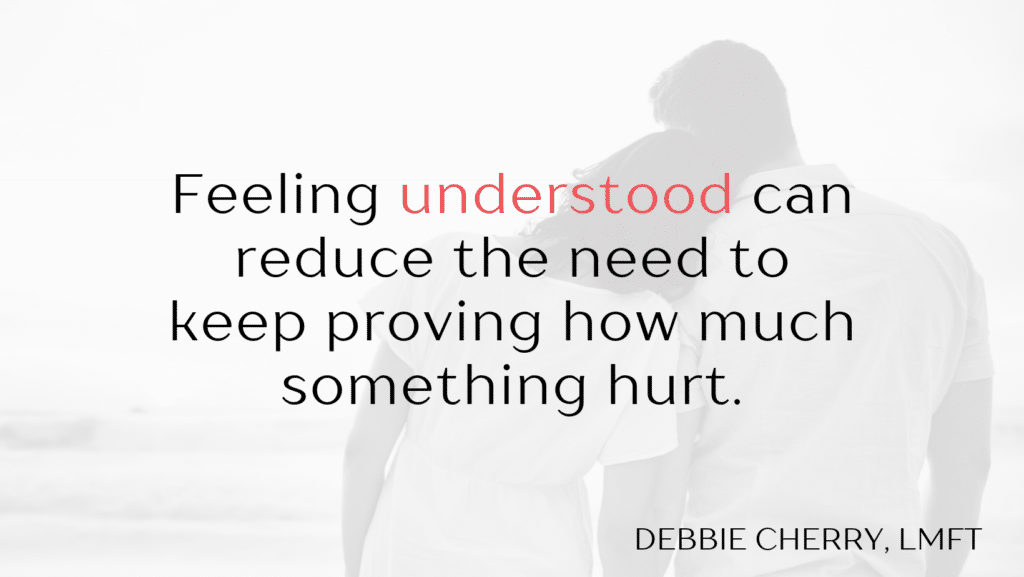
The deepest relief often comes when your partner no longer feels alone in the experience.
The Goal of Empathy Is Simple
The Partner Empathy Map is built around one basic idea:
Help your partner feel less alone in what happened.
That does not mean deciding that their version is the only version.
It does not mean abandoning your own experience.
It means getting curious enough to step out of your own perspective temporarily and try to understand theirs.
Not:
How would I have felt if this happened to me?
But:
What was this like for my partner, given who they are?
Their history.
Their fears.
Their personality.
Their strengths.
Their vulnerabilities.
The things that matter most to them.
The way they make sense of the world.
That distinction matters. The exercise is designed to help you understand your partner’s experience based on their inner world, rather than simply putting yourself into the same situation and imagining your own reaction.
Try the Partner Empathy Map
Choose a relationship hurt that still feels unfinished.
Then set your own story aside for a few minutes.
You can come back to what you meant, what you remember differently, and what you need your partner to understand about you.
For now, stay with their side.
The Partner Empathy Map walks you through four areas: Hear, Feel, Think, and Impact.
HEAR: What Did Your Partner Receive From You?
Ask yourself:
What did they see and hear from you?
What message did your words or actions send to them?
What did they want to hear from you most?
This is where intent and impact can be very different.
Maybe you went quiet because you were overwhelmed.
Your partner may have heard:
I don’t care.
Maybe you tried to explain yourself.
Your partner may have heard:
Your feelings are wrong.
Maybe you thought you were giving them space.
They may have experienced:
You left me alone.
The question is not only what did I mean?
It is also:
What did my partner experience from me?
FEEL: What Was Happening Emotionally?
Ask:
How were they feeling?
What makes sense about that?
What was the worst part?
Try to get underneath “angry.”
Maybe they felt scared.
Dismissed.
Rejected.
Embarrassed.
Unimportant.
Abandoned.
Betrayed.
Powerless.
Or simply very alone.
“What makes sense about that?” is especially important.
You are trying to understand how their emotional response fits with their experience—not decide whether you would have reacted the same way.
THINK: What Did It Mean to Them?
Ask:
What did they think to themselves?
What did they think should have happened?
What old fear might this have touched?
Painful experiences rarely stay limited to the facts.
Our minds attach meaning to them.
I’m not important.
You chose something else over me.
I can’t trust you.
I knew I would end up alone.
My needs are too much.
You don’t really know me.
The story may not perfectly reflect what you intended.
You can still understand why your partner’s mind went there.
IMPACT: What Happened Afterward?
Ask:
What did they do in response to the pain?
How did this impact them day to day?
What might still feel unresolved for them?
Maybe they became quieter.
More guarded.
More questioning.
Less affectionate.
More anxious.
Less willing to depend on you.
Maybe they keep returning to one specific question.
Maybe something that used to feel easy between you now feels risky.
Understanding impact means looking beyond the original incident and noticing what your partner may still be carrying because of it.
Write It Down Instead of Just Thinking About It
You can mentally run through the questions.
But writing can make the exercise more useful.
Writing your responses by hand can slow the process down, help you stay with the experience longer, and make it harder to jump straight into explaining yourself.
Try to answer as your partner, not as you explaining your partner.
There is a difference between:
They probably felt abandoned, but I only left because they was yelling.
and:
They may have felt abandoned. They may have thought I was leaving them alone right when they needed reassurance most.
The second answer stays in her experience longer.
That is the exercise.
Then Check Whether You Actually Got It Right
Once you have completed the map, do not assume you are done.
Bring it back to your partner.
You can talk through your responses, let them read what you wrote, or bring it into therapy if the experience feels too difficult to work through alone.
Then ask:
“Did I get that right?”
And:
“What am I still missing?”
Listen to the answer.
Let them correct you.
Let them add something.
Let them tell you which part mattered most.
Try not to immediately explain why they misunderstood you.
There will be time for your perspective.
Right now, you are trying to understand theirs.
Validation Does Not Require the Same Reality
Two people can experience the same relationship moment very differently.
You might sincerely remember it another way.
You might have information your partner did not have.
Your intentions may have been completely different from the impact.
None of that prevents empathy.
Validation means being willing to understand why the experience made sense from your partner’s point of view and acknowledging the impact it had on them.
You might say:
“I remember parts of it differently, but I understand why that felt so hurtful to you.”
Or:
“I get why that felt like I wasn’t there for you.”
Or simply:
“I understand why you felt so alone.”
Empathy is the bridge between two different realities.
You do not have to collapse those realities into one.
You need enough of a bridge to reach each other.
Sometimes Both Partners Need the Map
Relationship hurt is not always one-directional.
Sometimes both people walked away hurt, defensive, misunderstood, or alone.
In that case, each person can complete a Partner Empathy Map for the other.
Take turns.
Give each person’s experience room.
Other times, one person is carrying more of the pain.
Maybe there was a betrayal, a significant breach of trust, or an action with a much bigger impact on one person.
Then repair does not have to be perfectly symmetrical.
Sometimes one person needs to feel heard first.
Follow where the hurt is.
What You Need to Feel Understood
Relationship ruptures can make it hard to think clearly.
When attachment gets threatened, the brain can shift into survival mode. Thinking often becomes narrower, more absolute, and more focused on danger.
While your partner completes the Partner Empathy Map, take a few minutes to think about what would help you feel more understood and what you may still need in order to begin moving forward.
What do you wish your partner understood about the impact?
What would meaningful repair look like to you?
What do you still find yourself wondering about?
What would help you feel less alone in this?
What do you need your partner to be patient with?
What would repair look like in actions, not just words?
What small change would help you feel a little safer this week?
The bridge back to connection is built when each person feels that their inner experience matters to the other.
Repair Still Requires Action
Feeling understood is powerful.
It is not a substitute for changing behavior.
If trust has been damaged, words alone will not rebuild it.
You may need:
greater honesty,
new boundaries,
follow-through,
different choices,
more consistency,
more transparency,
or time and repeated experiences that show something has genuinely changed.
Empathy helps you understand what needs repairing.
Your actions afterward show whether the repair sticks.
You Don’t Have to Keep Rehashing the Past Forever
There is an important difference between going back to a painful experience intentionally and returning to it again and again without ever feeling resolved.
The goal of the Partner Empathy Map is not to keep couples living in the past.
It is to give the hurt enough attention that it can begin to take up less space in the present.
Sometimes what keeps an old experience active is the sense that it still has not been fully seen.
When the experience finally lands with the other person, something can shift.
The past still happened.
But you are no longer quite as alone in it.
And that can make moving forward feel very different.
A Note About Bigger Relationship Hurts
Some relationship ruptures are too painful or complex to work through with a worksheet alone.
Infidelity, major betrayal, trauma, abuse, coercion, threats, or concerns about emotional or physical safety may require professional support.
Use the Partner Empathy Map at a pace that feels safe. It should never be used to pressure someone to forgive, reconcile, disclose more than they are ready to share, or move forward before they are ready.
This resource is for education and reflection and is not a substitute for individualized therapy or professional care.
Download the Partner Empathy Map
You can use the questions above on their own, or download the printable Partner Empathy Map and write through the exercise more slowly.
You may not be able to undo what happened.
You may not agree on every detail.
You may still have work to do afterward.
But when each person feels that their inner experience matters to the other, the bridge back to connection gets stronger.
Repair does not require one version of what happened. It requires room for both.
keep connecting,
Debbie Cherry, LMFT
FAQs About Relationship Hurt and Repair
What is relationship hurt?
Relationship hurt is emotional pain that happens when something between partners affects trust, connection, security, or the sense that you matter to each other. It can come from one painful event, repeated behaviors, unmet expectations, conflict, dishonesty, emotional distance, or a significant betrayal.
The same experience can affect each person very differently depending on their history, fears, needs, and perspective.
Why does relationship hurt feel so painful?
The pain is often about more than the event itself. When the person you rely on most is also the person who hurt you, it can affect your sense of emotional safety and make you feel deeply alone.
Fear, anger, sadness, anxiety, and other intense emotions can become stronger when the relationship no longer feels as secure as it did before.
Can past relationship experiences affect how relationship hurt feels now?
Yes. A past relationship, experiences in other relationships, or something that happened with a family member can shape what feels especially painful in the present.
For example, if you have a history of feeling overlooked, abandoned, criticized, or betrayed, a current relationship rupture may touch that old fear and lead to stronger emotions than your partner expects.
That does not mean your reaction is only about the past. What happens across your life and relationships can shape how you experience closeness, conflict, trust, and emotional safety now.
How do you heal relationship hurt?
Healing often involves both understanding and change. The person who feels hurt may need their experience acknowledged, while the relationship may also need new behaviors, clearer boundaries, greater honesty, accountability, or different habits moving forward.
The Partner Empathy Map focuses on one important part of that process: understanding the hurt from your partner’s perspective so they do not have to keep carrying the emotional pain alone.
Can you rebuild trust after someone has hurt you?
Sometimes. Rebuilding trust usually takes more than an apology. It may require consistent behavior over time, taking responsibility, respecting boundaries, acknowledging the impact of what happened, and creating new experiences that help both partners feel safe again.
Change usually happens over the long run through repeated actions rather than one perfect repair conversation.
What if my partner and I have completely different realities about what happened?
That is common.
Two people can remember the same interaction differently and still acknowledge each other’s feelings and perspective. You do not have to agree on every fact or interpretation to understand why something hurt.
The goal is to make room for both realities without turning the conversation into a fight over whose experience is more valid.
Why does my partner keep bringing up the past?
Sometimes a past hurt keeps coming up because part of the experience still feels unresolved. A person may still be trying to understand what happened, get an important question answered, feel heard, or know that their partner truly understands the impact.
That does not mean every past issue needs to be discussed indefinitely. But acknowledging what still matters can sometimes help stop the same painful conversation from repeating.
What if both partners feel hurt?
Then both experiences matter.
Sometimes both people benefit from completing the Partner Empathy Map for each other and taking turns listening. In other situations, one person may be carrying significantly more pain, and it can make sense to focus on that experience first.
Mutual understanding does not require pretending every action had the same impact.
What if the relationship hurt involves infidelity or a major betrayal?
Major betrayal can affect trust, intimacy, emotional security, and a person’s sense of reality in the relationship. In those situations, empathy can be an important part of repair, but it may not be enough on its own.
Couples therapy or other professional help may be useful when the pain feels overwhelming, trust has been seriously damaged, conversations repeatedly escalate, or the couple has trouble making progress without support.
How do I know whether to work through hurt or set boundaries?
Understanding your partner does not require accepting every behavior.
Healthy repair can include empathy and boundaries. If a behavior continues to cause harm, you may need to clearly communicate what needs to change, what you are willing to accept, and what you will do to protect your own well-being.
A boundary is not punishment. It is information about what you need in order to participate safely and honestly in the relationship.
What can help while we are working through relationship hurt?
Self-care matters, especially when emotions are intense. That might mean getting enough sleep, eating regularly, moving your body, journaling, taking some space, or spending time with supportive friends or a trusted family member.
Protecting your friendship with your partner can matter too. Even during a difficult period, small moments of warmth, humor, kindness, or normal everyday connection can remind both of you that the relationship is bigger than the problem you are trying to solve.
You can also prepare for a repair conversation by writing down what you want your partner to understand, what still feels unresolved, and what would help you feel safer moving forward.
Taking a pause does not have to mean cutting off contact or avoiding the issue. Sometimes a short break is a good thing because it gives both people a chance to return with more clarity and less reactivity.
Can relationship hurt lead to lasting change?
It can. Painful experiences can lead to greater understanding, stronger boundaries, more honest communication, and healthier relationship habits when both people are willing to learn from what happened.
But permanent change rarely comes from one conversation. What matters more in the long run is what happens repeatedly over time. Empathy can begin the process, while responsibility, consistency, and follow-through help rebuild trust.
Sometimes relationship hurt becomes a turning point in a marriage or partnership. In other cases, it may lead someone to question whether the relationship can continue or whether a breakup is the healthiest next step. Repair is not about forcing one particular outcome.
Can empathy fix every relationship problem?
No. Empathy can help partners understand each other and feel less alone, but it cannot create change by itself.
Some problems require behavior change, accountability, boundaries, treatment for mental health concerns, or difficult decisions about the future of the relationship. Sometimes the work is about repairing the marriage or partnership. Other times, it is about gaining enough clarity and understanding to make thoughtful decisions about what comes next.
Important Note About Safety and Professional Support
Relationship hurt is inevitable, but some situations carry more risk than others. The Partner Empathy Map is designed for education, reflection, and relationship-building. It is not a substitute for couples therapy, individual therapy, mental health treatment, medical care, crisis support, or other individualized professional help.
If the relationship involves abuse, coercive control, threats, stalking, intimidation, physical violence, sexual violence, severe emotional abuse, or fear for your safety, the priority is not mutual empathy or relationship repair. Focus on safety and seek qualified professional support. Staying connected with trusted friends, a family member, or other safe sources of support can also be important.
The Partner Empathy Map should never be used to pressure either person to accept harmful behavior, forgive before they are ready, remain in an abusive relationship, disclose more than feels safe, give up needed boundaries, or take responsibility for someone else’s choices.
If relationship pain is affecting your emotions, sleep, daily functioning, mental health, sense of freedom, or overall well-being, consider reaching out for professional help. A qualified therapist can help you understand what is happening, prepare for difficult conversations, assess risk, and decide what support you may need next.
In cases of infidelity, major betrayal, trauma, longstanding conflict, or repeated relationship ruptures, couples therapy may provide a more structured process for understanding what happened, rebuilding trust where appropriate, clarifying boundaries, and deciding what each person needs moving forward.
The goal of the Partner Empathy Map is to support greater understanding while respecting each person’s boundaries, safety, freedom, and well-being.
This blog is for educational purposes only and is not a substitute for therapy, diagnosis, or individualized mental health care. Reading this article does not create a therapist-client relationship with Debbie Cherry, LMFT. If you would like more personalized support, you are welcome to schedule an appointment.