
Conflict Is Not The Real Problem
That is one of the clearest takeaways from relationship research. Gottman’s research says that most relationship issues are perpetual — about 69% of them, meaning they never fully get resolved. Differences in personality, values, money habits, in-laws, or how you load the dishwasher will still be there in ten years.
What actually predicts whether a couple stays happily together isn’t how often they fight or even what they fight about. It’s how they treat each other in the middle of the fight.
Gottman describes stable romantic relationships as one that has five positive interactions for every one negative one, even during conflict. In other words, relationship success is not the absence of hard moments. It is the ability to minimize escalation, repair a relationship quickly, and create enough positivity to stay connected.
The Hidden Force Behind Defensive Cycles
The reason conflict escalates so fast is that it often stops being just about the issue. The moment one or both partners feel criticized, rejected, controlled, blamed, or emotionally unsafe, survival mode can take over. The nervous system shifts toward self-protection, and that makes it much harder to stay calm, respectful, open, or warm. Instead of bringing in the positivity and repair that strong relationships need, couples start reaching for old defenses like attack, shutdown, control, or blame. In other words, the real force behind cycle is often not the disagreement itself, but the threat response it triggers.
Don’t Let Autopilot Drive
When people get upset, they do not automatically become their wisest selves. Under stress, people tend to fall back on more automatic defensive responses. If you are not intentional, you are very likely to fall back on the same protective habits and get the same painful outcome. When you do not tell the conversation where to go, your survival brain will usually drive it somewhere familiar.
The Roles That Push Couples Apart
When fight-or-flight is activated during conflict, the nervous system doesn’t just change how you think — it changes how you act.
To regain a sense of control or safety, people fall into predictable protective roles. Psychologists call this pattern the drama triangle. These roles are not character flaws. They are nervous-system defenses.
Victim — Self-Protection Through Collapse
“This is happening to me.”
The nervous system goes into helplessness. You may shut down, withdraw, freeze, or wait to be rescued. Underneath is a fear of being overwhelmed, abandoned, or unseen. The more powerless one person feels, the louder the conflict gets.
Persecutor — Self-Protection Through Attack
“You’re the problem.”
The nervous system moves into fight. You criticize, blame, or escalate to regain control or be heard. Underneath is a fear of powerlessness or not mattering. The more one partner attacks, the more the other withdraws.
Rescuer — Self-Protection Through Over-Functioning
“Let me handle this.”
The nervous system manages anxiety by fixing, managing, or smoothing things over while abandoning your own needs. Underneath is a fear that the relationship will fall apart if you don’t intervene. The more one rescues, the less equal the relationship feels.
Partners often rotate through all three roles—sometimes within the same conversation. Each role offers temporary relief, but all of them block real connection. What looks like stubbornness or incompatibility is usually a nervous system trying to survive a perceived attachment threat. Insight alone doesn’t stop this cycle. The body has to feel safe first.
How to Stop Escalating Conflict Quickly
In the heat of the moment, your brain defaults to old coping patterns, childhood defenses, and survival strategies that once kept you safe. And when one person goes harder into one role, the other person often gets pulled more deeply into a complementary role. One partner blames harder, the other gets more defensive. One person collapses, the other overfunctions. One controls, the other pushes back.
Unless you very intentionally redirect it, you’ll end up on the same old road and get the same painful outcome you’ve always gotten. That’s why hoping things will “just calm down” or waiting for your partner to change almost never works. You have to choose the outcome you actually want and say it out loud. Clear intentions pull both of you out of enemy mode and back onto the same team.
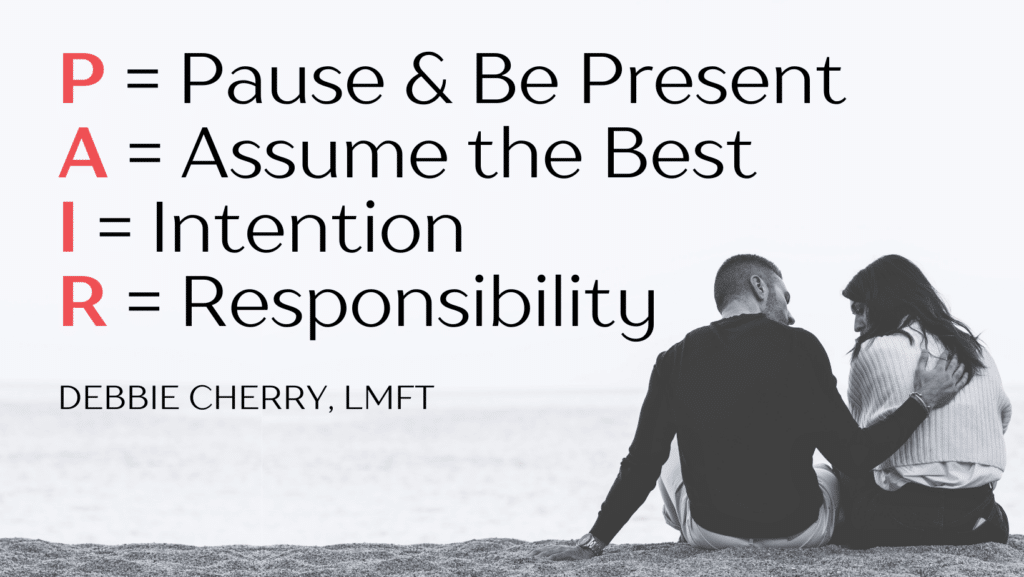
This is where the second half of the PAIR steps to resolve couples conflict comes in. Right after you anchor yourself in the present moment and assume the best, the next two moves are what help stop the spiral: state your intention and take responsibility.
Intention Keeps Conflict From Running the Show
Intention means naming the outcome you actually want instead of letting survival mode take over. It gives both of you a direction and helps redirect the moment before it spirals. For example:
- “Let’s slow this down and really hear each other.”
- “Let’s take ten more minutes and try to end in a better place.”
- “Let’s take a minute to breathe and remember we’re on the same team.”
One sentence. That’s it. It interrupts the old loop and gives your brain a new destination.
Repair Requires Responsibility
Responsibility is not the same as blame. It does not mean taking all the fault, ignoring your hurt, or acting like your needs do not matter. Responsibility means asking, What can I do right now to make this better instead of worse? That question shifts you out of defensiveness and back into agency. It helps you step out of blame and helplessness and return to what actually repairs relationships: ownership, restraint, and a willingness to change your part of the pattern.
This is also what helps couples step out of the drama triangle. When people feel hurt or out of control, they often slip into blame, helplessness, or overfunctioning. But the more each person gets pulled into one of those roles, the more the pattern hardens and the less safe and connected the relationship feels. Responsibility interrupts that cycle. One of the fastest ways to repair is to begin with the words I will.
- “I will focus on one thing at a time.”
- “I will listen without interrupting.”
- “I will come back in 10 minutes when I calm down.”
These are small moves, but they are powerful ones. Responsibility is what turns repair from a good idea into a real action. It is how you stop feeding the pattern, protect trust, and start creating a different outcome.
✅ Repair conflict faster. Download the free Repair Scripts for simple intention and responsibility phrases you can use in the moment (no email needed).
Why the 5-to-1 Ratio Matters So Much
The 5:1 finding does not mean couples should fake positivity or avoid hard truths. It means that during conflict, relationships do better when negativity is buffered by enough signals of warmth, respect, openness, and goodwill. In Gottman’s writing, examples of positive behaviors during conflict include affection, humor, interest, validation, de-escalation, and accepting influence. Positive affect during conflict has also been linked to better long-term relationship outcomes in Gottman-related research.
Sometimes those positive moments are very small:
A warm look.
Eye contact.
A softer voice.
A hand on the shoulder.
A slight smile.
A nod that says, “I’m still with you.”
A sincere “That makes sense.”
A quick apology.
A genuine effort to understand.
These moments matter because they keep conflict from turning into emotional abandonment. They communicate, “I may be upset, but I am not leaving you emotionally.” That kind of connection is deeply regulating and helps both partners feel that the bond is still there, even in the middle of something hard.
Repair Restores Connection
Most couples think the goal during conflict is to “solve the problem” or “win the argument.” Research suggests that strong couples are not the ones who never struggle. They are the ones who know how to repair quickly so the positive interactions outweigh the negative ones. They know how to soften instead of harden, reconnect instead of retaliate, and bring enough warmth, care, and responsibility into hard moments to keep turning back toward each other.
So the formula is not “never fight.”
The formula is more like this: expect conflict, repair quickly, and actively outweigh the hard moments with enough positive ones to keep the relationship emotionally safe.
That is why the second half of PAIR matters so much.
State your intention.
Take responsibility.
Those two moves can shift the entire tone of a conflict. They interrupt autopilot, restore agency, and help both partners remember that the relationship matters more than winning the moment.
Conflict is inevitable. Damage is not. Repair is what protects the bond.
Keep connecting,
Debbie Cherry, LMFT
DO YOUR FIGHTS KEEP GOING IN CIRCLES?
💝 Download the free Connected Communication Toolkit with practical tools to help you repair faster, know what to say, and reconnect.
📅 You can also schedule a complimentary consultation or session when you’re ready to reset patterns and move forward with more teamwork.
Next Step ➡️ Break the Blame Cycle with These Relationship Check-In Questions
💬 Frequently Asked Questions About Relationship Repair
How do you repair a relationship when conflict happens on a regular basis?
Repairing a relationship starts with a conscious effort to pause the conflict process before it gets worse. Gottman describes a repair attempt as anything that prevents negativity from escalating. In real life, that can mean taking a break, using active listening, avoiding name-calling and character assassination, and choosing the right frame for moving forward. The important thing is to take responsibility, show self-accountability, and use simple tools that help both human beings stay connected.
What are repair attempts in romantic relationships?
In romantic relationships, repair attempts are small things a partner does in a difficult moment to reduce hurt feelings, lower emotional pain, and create mutual understanding. A repair attempt might be a soft tone, eye contact, validation, or saying, “Let’s start over.” A simple repair checklist can help: pause, listen, validate, and make one positive thing happen. Receiving repair attempts to help resolve couples conflict also matters, because repair works best when both people are involved in the process.
Can couples therapy help a broken relationship?
Yes. Couples therapy can help a broken relationship, ongoing relationship issues, and deeper relationship difficulties, especially when old hurts from the past keep showing up in the present. A licensed marriage and family therapist in private practice can offer support, help couples develop better repair habits, and teach them how to repair effectively. Professional help is often the key when couples feel stuck, need a fresh start, or want to protect the relationship as a non-negotiable part of life.
Why do couples get stuck in the same fight?
Couples often get stuck because conflict activates old defenses tied to the past, fear, and identity. Then the issue becomes less about the original idea and more about protection, blame, and pain. When that happens, it is harder to hear your partner, harder to show positive feelings, and harder to make repair attempts. The key is to slow the moment down, create space, and shift from reaction to responsibility.
What does repair look like in everyday life?
On a regular basis, repair looks small but meaningful: “I’m sorry,” “I hear you,” “I will slow down,” or “Let’s take a break.” These actions help couples move from hurt feelings to mutual understanding and from disconnection to connection. The goal is not perfection. The goal is to make a real attempt to protect the relationship, reduce emotional pain, and keep moving forward together with more care.
📚 References & Resources About Repairing A Relationship
The Karpman Drama Triangle – The drama triangle helps explain why conflict can feel so stuck and repetitive. When people feel hurt, powerless, or emotionally unsafe, they often slide into one of three protective roles: Victim, Rescuer, or Persecutor. These roles may offer temporary relief, but they rarely create real repair. Instead, they keep couples polarized, reactive, and disconnected. The more one person leans into a role, the more the other often gets pulled into a complementary one. That is why blame, helplessness, and overfunctioning can escalate a fight so quickly. The goal is not to label each other, but to notice the pattern and step out of it before it takes over.
Escaping The Drama Triangle – This PDF explains the Karpman Drama Triangle, a model of dysfunctional conflict in which people under stress slip into three reactive roles: Victim, Rescuer, and Persecutor. It shows how people can rotate among these roles quickly, how the pattern blocks honest problem-solving, and why it often damages communication, trust, and relationships instead of resolving the real issue.
R is for Repair / Gottman– This Gottman article explains repair attempts as the small words and actions that prevent negativity from escalating out of control. It’s a helpful resource for understanding why repair matters so much and how even simple moments can shift conflict back toward connection.
Fight Right by John and Julie Gottman – A newer Gottman book focused specifically on conflict. It is a practical guide to helping couples calm down, stay connected, and fight in a way that brings them closer instead of farther apart. Good fit if you want a book reference tied directly to repair and conflict process.
The Seven Principles for Making Marriage Work by John Gottman and Nan Silver – A classic Gottman book that gives the broader foundation behind repair, positivity, and relationship stability. Helpful if you want one core Gottman book in your resources section rather than several blog links.
Next Step ➡️ Break the Blame Cycle with These Relationship Check-In Questions