
Effective Communication Strategies for Couples Stuck in Negative Loops
You know that talking harshly to each other only leads to more distance, but somehow… it just keeps happening.
There is nothing more painful than feeling alone… next to the person who used to understand you the most.
The SEEN Tool is designed for real relationships… the ones where love runs deep, but triggers do too.
Why Tiny Misunderstandings Turn Into Big Arguments
Most couples think they fight about dishes, money, or schedules.
They don’t.
They fight because someone doesn’t feel seen.
When you feel misunderstood, dismissed, or emotionally alone, your nervous system switches into fight-or-flight. You stop listening. You start protecting. And suddenly the person you love feels like the enemy.
No one feels heard.
No one feels safe.
And nothing actually gets resolved.
What Recurring Arguments Are Really About
According to relationship researchers John and Julie Gottman, about 70% of couples’ problems are perpetual — even in happy relationships. They don’t disappear.
What matters isn’t eliminating differences.
It’s how you speak to each other when you don’t see eye to eye.
When couples argue, they’re usually not asking about the dishwasher.
They’re asking:
-
“Do I matter?”
-
“Can I trust you?”
-
“Will you show up for me?”
Arguments aren’t about the surface issue.
They’re about connection.
How to Stop Arguing About the Same Things
The fastest way to calm a conflict isn’t better logic — it’s better listening.
When you pause to reflect before you respond, you send a powerful signal:
“You matter more than being right.”
Most couples stay stuck because the same emotional pattern keeps repeating:
feeling unheard → reacting → defending → disconnecting.
You break the loop by doing something different.
The SEEN Tool: Your Shortcut to Feeling Understood
Master these four skills to communicate in a way that strengthens your bond, not your defenses. These research-based skills, refined over 20+ years of counseling couples, transform conflict into connection.
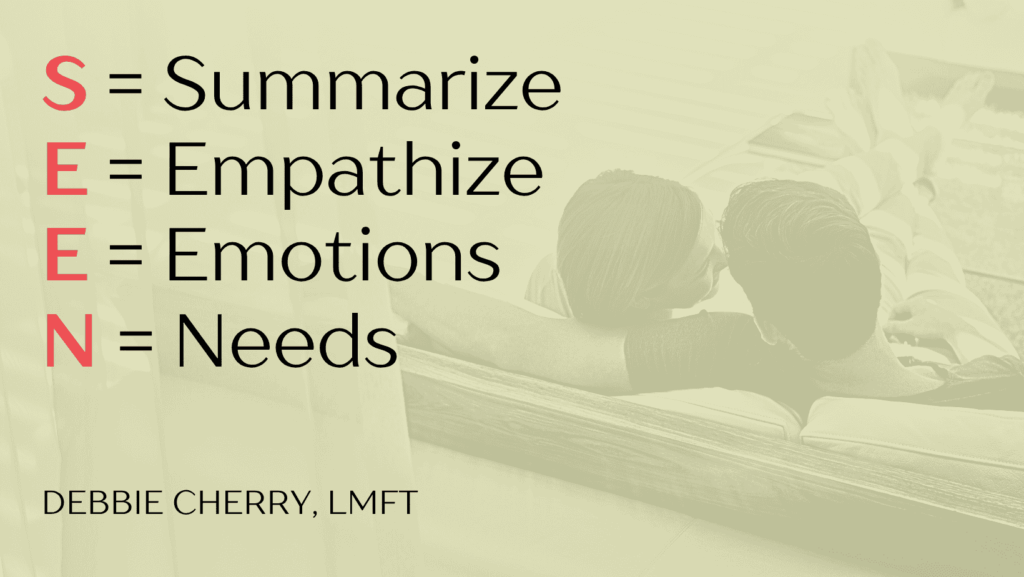
SKILL #1 — S = Summarize Before You Defend.
Repeat back what you hear.
Start with: “I hear you saying…”
Active listening calms both of your nervous systems.
SKILL #2 — E = Empathize With Feelings.
Acknowledge their emotional experience.
Say: “I can see how that would feel…”
You don’t have to agree to be compassionate.
SKILL #3 — E = Express Emotions, Not Blame.
Share what’s happening inside you.
Say: “I feel [emotion]…”
“I” statements keep the conversation safe and open.
SKILL #4 — N = Name Needs, Not Complaints.
Say what you want instead of what you don’t.
Say: “I need [specific need]…”
Requests build connection. Criticism builds walls.
📸 Snap a screenshot of the SEEN Tool to use when it matters most.
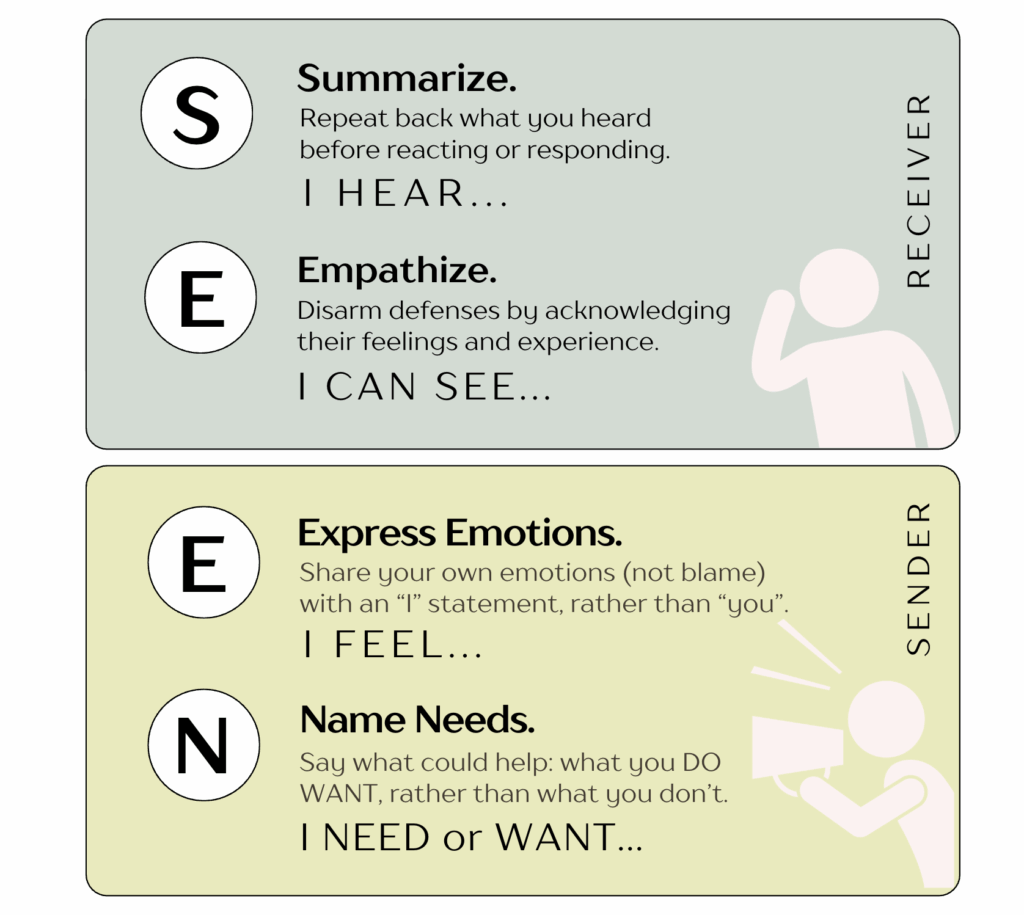
✅ Communicate with clarity and care. Download the free SEEN Tool — instant access, no email required.
Healthy Communication Is Playing Catch, Not Proving a Point
Think of communication like emotional catch.
You have to receive before you throw.
Listener
-
S — “I hear you had a long day.”
-
E — “I can see why that was exhausting.”
Speaker
-
E — “I feel overwhelmed.”
-
N — “I need some quiet time to reset.”
When both people follow the same rules, the fight dissolves.
Secure Couplehood Starts With You Both Feeling Heard
You don’t have to solve every problem to feel close.
You just have to stay connected.
You can’t argue your way back to love.
You can only understand your way there.
“When you both feel seen, you don’t have to fight to be heard.”
Practice SEEN in small, calm moments.
Those micro-moments train your nervous system to connect instead of defend.
keep connecting,
Debbie Cherry, LMFT
READY TO READY TO STOP FIGHTING THE SAME OLD FIGHTS?
💝 Grab the free Connected Communication Toolkit built for couples who want fewer fights and faster repair.
📅 Book an appointment for a free consultation or a session to help you reset conflict patterns in real time.
Next Step ➡️ Feel Heard Fast With These 25 Interesting Questions To Ask Your Partner.
💬 Frequently Asked Questions About How to Stop Arguing & Improve Communication
1. Why do we always end up in the same argument, even over small things?
It’s rarely just about dishes or dinner. These small moments often lead to big tension because they tap into deeper feelings like doing all the work, not feeling noticed, or feeling unappreciated. Over time, that emotional load builds up, and even the first thing that goes wrong can trigger a reaction. What looks like a fight about the surface is really a sign that something underneath needs attention. When you realize that the difference between what you see and what your partner feels is not about being wrong but about wanting to be heard, you can start to make sense of each other again. Pay attention to body language and tone, since those often reveal what words cannot.
2. How do we stop getting so angry over the little things?
If you feel angry, mad, or even a bit anxious, that’s a signal your brain has moved into fight-or-flight mode. This can happen over seemingly small behaviors, like tone of voice or how someone says certain words. When something hits in a certain way, it may remind you of past hurt and the reaction feels bigger than the moment. Learning to pause and summarize what you heard before reacting gives your brain a moment to reset. You might realize that anger often shows up when you don’t feel seen or understood. If you wait before speaking, you’ll notice a real difference in how your partner can hear you and respond.
3. Why does one mistake lead to a full-blown argument?
One small mistake, a comment, an unmet need, or a shift in tone can feel huge when you’re carrying unresolved emotional weight. You may assume your partner meant something hurtful, and your brain fills in the blanks. In long-term relationships, we tend to tend toward old roles or patterns. But when you stop to clarify instead of react, you can deal with the real issue instead of escalating. Sometimes what feels wrong is actually a misunderstanding that needs evidence of care, not proof of guilt. Take a moment to sit together, breathe, and reflect on what each of you is truly trying to say before anger takes over.
4. What should I do when my partner gets defensive or shuts down?
Defensive reactions are usually signs of deeper emotions like hurt, shame, or fear. Instead of pushing, try using words like “I feel” instead of “You never.” Share how something made you feel and what you need, without blaming. For example, “I felt unseen when you walked away,” instead of “You always ignore me.” This kind of responsibility-based communication helps shift power from blame to understanding. When you sit calmly and hear your partner, you create a sense of safety that helps both of you stay present. The key difference comes when you respond to emotion, not accusation, especially at night when you’re both tired and reactive.
5. How can we communicate better about the real issues?
Big topics like money, raising kids, or unmet needs often get clouded by day-to-day stress. You may feel like you’re spending all your energy trying to resolve something, but nothing changes. That’s where structure helps. The SEEN method creates a safe container to express your truth without judgment. It slows things down so you can both be present, express your effort, and figure things out without making a mess of the moment. When you realize you can hear and be heard without interruption, everything changes. Practicing this in the course of your daily life helps you stay connected and reduce anger before it builds. If you want to deepen your communication skills and accelerate your progress, you can book a free consult to see if couples communication therapy might be the right next step for you.
6. What therapeutic approaches inform the SEEN method?
My approach integrates several evidence-based therapy models that all point to the same core understanding:
Most conflict in relationships is a nervous-system event rooted in attachment needs, emotional meaning-making, and old patterns—not a sign of incompatibility.
The SEEN method is grounded in these research-based frameworks:
Attachment Theory (Bowlby, Ainsworth, Hazan & Shaver)
Attachment science explains why conflict escalates so quickly. When you don’t feel seen or understood, your nervous system experiences it as a threat to the bond. This triggers instinctive protest behaviors such as defensiveness, criticism, withdrawal, or shutting down.
SEEN helps regulate these responses so you can reconnect instead of react.
Emotionally Focused Therapy (EFT) — Dr. Sue Johnson
EFT focuses on the deeper emotions beneath the argument. Most couples aren’t fighting about chores or schedules—they’re fighting about feeling disconnected.
The SEEN steps support EFT’s process by helping partners slow down, identify underlying emotions, express needs clearly, and transform protest into connection.
Interpersonal Neurobiology & Dan Siegel’s Work
Dan Siegel’s research on the brain, integration, and the window of tolerance informs how I help couples communicate.
When partners summarize, empathize, and name emotions, they shift out of limbic reactivity and into a more integrated state where connection is possible.
The SEEN method uses these principles to help partners stay within their window of tolerance so they can think clearly, listen openly, and respond with care.
PACT (Psychobiological Approach to Couples Therapy) — Stan Tatkin
PACT blends attachment, developmental neuroscience, and arousal regulation. It emphasizes how partners manage threat in real time.
SEEN aligns with PACT by helping couples:
-
co-regulate before problem-solving
-
use facial expressions, tone, and micro-cues to stay connected
-
move from self-protection into secure-functioning teamwork
Stan Tatkin’s secure-functioning concepts are foundational to how I teach partners to become a team.
Nonviolent Communication (NVC) — Marshall Rosenberg
NVC emphasizes expressing needs, feelings, and requests without blame or judgment.
This framework directly informs SEEN’s “Express Emotions” and “Name Needs” steps, helping partners communicate clearly and compassionately.
Imago Relationship Therapy — Harville Hendrix & Helen LaKelly Hunt
Imago explores how childhood experiences shape adult conflict patterns.
SEEN supports Imago principles by giving partners a structure to listen without defensiveness, validate each other’s inner world, and reduce reactivity in moments of tension.
Gottman Method Couples Therapy
John and Julie Gottman’s research shows that positive regard, gentle start-ups, de-escalation skills, and repair attempts predict long-term relationship success.
The SEEN steps help create these conditions automatically during communication.
Narrative Therapy & The Stories Our Brain Tells
Narrative therapy helps partners understand that the mind creates meaning through stories—stories about the relationship, about intention, and about ourselves.
In conflict, these stories often become distorted or overly negative due to past pain or perceived threat.
SEEN interrupts these “automatic narratives” by helping partners reflect, clarify, and check accuracy before reacting to old storylines.
Psychodynamic Principles
Psychodynamic insights help explain why deeper fears—like abandonment, not being enough, or losing connection—show up in small moments.
SEEN makes these unconscious triggers easier to recognize by slowing down both partners’ responses so they can stay present instead of reenacting old patterns.
Needs-Based and Compassionate Communication Models
Across all these frameworks is one unifying principle:
Healthy communication is simply the ability to express emotions and needs in a clear, regulated, and compassionate way.
The SEEN method gives couples a simple, actionable structure to do exactly that.
7. How does the Gottman “Cascade Model” relate to communication and the SEEN method?
The SEEN method is also informed by the Gottman Distance & Isolation Cascade, a research-based model explaining how relationships break down when negative communication patterns go unchecked.
The Distance and Isolation Cascade describes four predictable stages:
-
Escalation
Arguments get louder, sharper, and more reactive. Fight-or-flight takes over, and partners stop listening. -
Invalidation
Partners dismiss, minimize, or criticize each other’s feelings. Emotional safety breaks down. -
Negative Interpretations
You start assuming bad intentions (“You don’t care,” “You’re trying to hurt me”), even when it’s not true. -
Withdrawal / Avoidance
Conversations become shorter, colder, and less frequent. Partners stop turning toward each other and begin turning away.
Over time, this cascade leads to emotional distance, loneliness, and a sense of living parallel lives instead of a shared one.
The SEEN framework interrupts this cascade at every stage:
-
Summarizing disrupts escalation by slowing the moment down.
-
Empathizing prevents invalidation by acknowledging the real emotion underneath.
-
Expressing emotions stops negative assumptions by bringing clarity to the conversation.
-
Naming needs replaces withdrawal with actionable connection.
The goal isn’t perfect communication — it’s preventing the cascade that erodes closeness and psychological safety.
When couples use SEEN proactively, they stop the spiral before it starts and rebuild a stronger “us.”
📚 References and Further Reading About Avoiding Arguments
Expressing Thoughts and Feelings Leads to Greater Empathic Accuracy During Relationship Conflict — Journal of Family Psychology (2021)
Sharing what you truly think and feel helps your partner understand you more accurately. This study of 155 couples found that open emotional expression during conflict improves empathic accuracy and strengthens connection, even when conversations feel tense.
Read the study on APA PsycNet →
Empathic Accuracy and Observed Demand Behavior in Couples — Frontiers in Psychology (2016)
This study found that empathic accuracy — the ability to understand a partner’s thoughts and feelings — drops when one partner becomes defensive or critical. In moments of tension, emotional attunement decreases, and misunderstandings escalate. The findings highlight why slowing down and truly listening can prevent small issues from spiraling.
Read the study on Frontiers →
Motivation and Empathic Accuracy During Conflict Interactions in Couples — Motivation and Emotion (2022)
Researchers discovered that partners who approached conflict with a relationship-serving motivation (seeking connection rather than protection) showed significantly higher empathic accuracy. When partners aimed to understand rather than defend, they communicated more effectively and resolved conflict with greater warmth.
Read the study on Springer →
NEXT STEP ➡️ Feel Heard Fast With These 25 Interesting Questions To Ask Your Partner.