Why Relationship Arguments Escalate So Quickly
Do you ever find yourself in an argument with your partner and think, “How did we even get here?”
You start with good intentions. You tell yourself to stay calm, be kind, and not go there again.
And then somehow… you’re both right back in it.
Voices sharper. Defenses higher. Saying things you do not mean. Feeling miles apart even though you are standing in the same room.
Sometimes it escalates so fast you cannot even remember what started it.
That is what a high-conflict loop can look like for couples stuck in the same patterns.
High-conflict couples tend to experience arguments that become more frequent, intense, reactive, and difficult to resolve than ordinary disagreements. But they are not necessarily fundamentally different from other couples.
Often, it is more useful to think of the problem as a high-conflict loop they keep getting pulled into—one that escalates quickly, brings old hurts into the present, and makes it harder to calm down, understand each other, or repair afterward.
And once that cycle gets going, your brain can begin working against you.
Three common cognitive biases can make your partner look worse, the relationship feel more threatening, and the argument seem more hopeless than it actually is:
Confirmation bias. Attribution bias. Negativity bias.
These mental shortcuts exist all the time. But when you are in survival mode, they go into hyperdrive and keep you stuck in couples conflict.
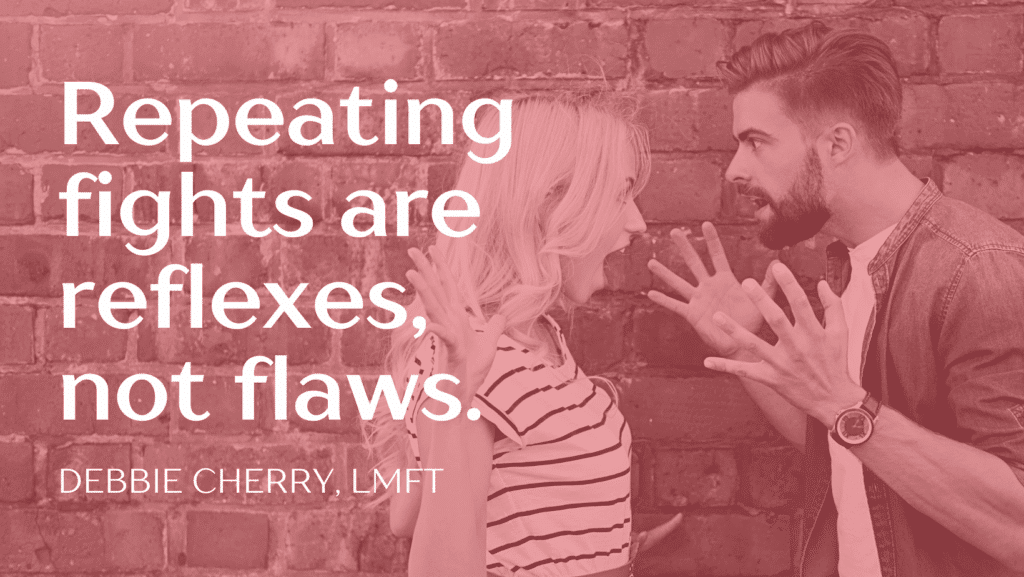
Recurring conflict is not necessarily a relationship flaw. Often, relationship fights are driven by a nervous-system reflex that shifts both partners from connection into protection.
Understanding these reactive patterns can help couples catch the loop earlier, regulate more effectively, improve communication during conflict, and get back on the same team faster.
High Conflict Is a Pattern, Not an Identity
The term high-conflict couples can sound like a permanent label, as if some couples are simply built to fight.
That is not how I think about it.
What matters more is the high-conflict loop that develops between two people.
One partner pushes harder to feel heard.
The other becomes overwhelmed and pulls away.
The more one pursues, the more the other retreats.
Or one criticizes, the other becomes defensive, and both begin protecting themselves instead of listening.
The issue is no longer simply the original disagreement.
The issue is that both partners have shifted from connection into protection.
High-conflict relationships are often marked by arguments that are more frequent, intense, quick to escalate, and difficult to repair. Old hurts get pulled into current disagreements, and both people may start expecting the next interaction to go badly before it even begins.
That expectation matters because your brain is always trying to predict what is about to happen.
And when it expects danger, it starts looking for it.
What Getting Triggered in a Romantic Relationship Really Means
When a situation echoes past emotional experiences held deep in the brain, your nervous system shifts into protection mode before conscious thought has a chance to step in.
So when disconnection hits, your internal alarm system fires.
Not gently.
More like a fire alarm being pulled.
Your brain flips into survival mode and starts running on a completely different operating system. The thoughtful, nuanced, compassionate parts go offline. The fast, reactive, black and white parts take over.
This mode is designed for emergencies, not intimacy.
It prioritizes self protection over connection. Certainty over curiosity. Winning over understanding.
And once you are in it, you literally cannot be the partner you want to be.
Empathy drops.
Listening narrows.
Compassion shuts down.
You are not thinking clearly. You are reacting instinctively.
During relationship conflict, your brain uses common cognitive biases as mental shortcuts to preserve energy, and to interpret information quickly. Your thinking becomes less objective and can distort what you notice and how you explain your partner’s behavior.
In a high-conflict loop, that distortion can become part of the loop itself.
That is why logic does not work in heated moments of conflict. That is why trying to prove your point makes things worse. And that is why the same fights repeat on loop.
Nothing changes until you calm the survival system running underneath it all.
The Fastest Way to Get Back on the Same Team
You cannot feel close while your nervous system is preparing for battle.
You do not have to memorize psychology terms in the middle of a fight.
You just need three simple minset shifts from the SAFE framework that counteract survival mode immediately and support emotional regulation in relationships.
1. Confirmation Bias Makes Your Brain Build a Case
Confirmation bias is the tendency to notice information that supports what you already believe while overlooking information that challenges it.
Suppose you already carry the painful belief:
My partner never listens to me.
Then during dinner, they glance at their phone while you are talking.
Your brain immediately says:
See? They never listen.
That moment fits your existing story, so it gets extra weight.
Meanwhile, your mind may barely register the conversation earlier that day when they listened carefully, asked questions, or tried to understand you.
Once your brain has a story, it starts collecting evidence for it.
In high-conflict loops, this can become especially destructive.
One missed text becomes:
You always forget about me.
One defensive response becomes:
You never care how I feel.
One bad night becomes:
Nothing ever changes.
The more evidence your brain gathers, the more certain the story feels.
And the more certain the story feels, the more likely you are to interpret the next interaction through it.
Your mind builds a case, not connection.
→ Counter Confirmation Bias with the 1st step in the SAFE Tool:
S — Self-Regulate
Regulation changes the conversation before a single word is spoken.
The moment you notice tightness in your chest, heat in your face, or sarcasm creeping in, pause. Those are early warning signals that your survival brain is taking over.
Before you react to the story your brain is telling you, slow things down enough to ask:
What actually happened?
What do I know versus what am I assuming?
Am I responding to this moment, or am I responding to every similar moment we have ever had?
Emotional regulation is not about suppressing what you feel.
It is about creating enough space between what you feel and what you do next.
Sometimes that means taking a breath, lowering your voice, unclenching your jaw, letting your partner finish, or taking a structured break before continuing.
You are not minimizing the problem.
You are preventing your entire relationship history from piling into the next thirty seconds.
2. Attribution Bias Turns Behavior Into Character
Attribution bias is assuming your partner’s behavior reflects who they are rather than what they are going through. Misunderstandings become personal attacks.
When we behave badly, we usually understand the circumstances.
I snapped because I was exhausted.
I forgot because I had too much going on.
I shut down because I felt overwhelmed.
But when our partner behaves badly, we are more likely to explain it through their character.
They snapped because they are mean.
They forgot because I am not important.
They shut down because they do not care.
Same type of behavior.
Completely different explanation.
Instead of talking about what your partner did, you begin deciding what their behavior means about who they are.
That is when frustration quickly becomes criticism.
“You forgot” becomes “You are selfish.”
“You were late” becomes “You do not respect me.”
“You needed space” becomes “You do not care about this relationship.”
In high-conflict loops, these interpretations raise the threat level almost instantly.
Now your partner is not just being asked to address a problem.
They are defending their character.
And defensive people rarely become better listeners.
→ Compensate for Attribution Bias with the 2nd step in the SAFE Tool:
A — Assume the Best.
This does not mean ignoring harmful behavior.
It does not mean excusing dishonesty, cruelty, abuse, or repeated mistreatment.
It means resisting the urge to automatically assign the worst possible motive to someone you love.
Assuming the best directly counterbalances your brain’s threat filter. Instead of defaulting to worst case interpretations, you intentionally lean the other way. This step is like counterbalancing on a sharp turn, you compensate for your brain’s negative tilt.
Instead of:
They do not care.
Try:
They may be overwhelmed.
Instead of:
They are intentionally ignoring me.
Try:
Something may be happening here that I do not understand yet.
Instead of:
They are trying to hurt me.
Try:
They may be having a hard moment and handling it badly.
There is a huge difference between:
“You forgot because you do not care about me.”
and:
“You forgot, and that really hurt. Help me understand what happened.”
One creates a courtroom.
The other creates room for communication.
3. Negativity Bias Makes the Bad Become the Whole Story
Negativity bias is the natrual tendency to focus on what feels wrong while filtering out what is working.
Your brain is wired to scan for potential threats first. Your survial system naturally gives negative information more attention than positive information.
When you are already hurt or angry, it can become even stronger.
You notice the sigh.
The eye roll.
The irritated tone.
The thing they forgot.
The chore they did not do.
The text they missed.
Meanwhile, all the ordinary caring things your partner did that day can fade into the background.
In a high-conflict loop, the negative can slowly become the entire relationship narrative.
Instead of:
We had a bad interaction.
it becomes:
Our relationship is bad.
Instead of:
My partner handled that poorly.
it becomes:
Everything about them irritates me.
The brain would rather assume danger than risk vulnerability. It is trying to protect you — but it narrows your perspective and distorts reality in the process.
Once that happens, resentment grows more easily.
And when positive regard disappears long enough, couples become more vulnerable to contempt, disgust, superiority, and disrespect.
→ Disrupt Negativity Bias with the 3rd step in the SAFE Tool:
F — Focus on Fondness.
Bring some of the good back into view.
Not fake positivity.
Not denial.
Something real.
Remember something you genuinely appreciate about your partner.
A quality you admire.
A way they contribute.
A memory that still makes you smile.
Something about them that reminds you:
That is my person.
Fondness allows two realities to exist at the same time:
I am really upset about what happened.
And:
I still care about the person sitting across from me.
That matters because high-conflict loops often pull couples toward all-or-nothing thinking.
Your partner does not have to become the enemy simply because something is wrong.
✅ Stop conflict spirals sooner. Download the free Bias To Bond Chart for quick, in-the-moment support.
SAFE Helps Change the Interaction, Not Just Your Thinking
The first three SAFE steps help counter the biases that distort what you see.
The fourth helps you decide what to do next.
E — Empower the Team.
High-conflict loops often become power struggles.
“Why should I change when you started it?”
“I will apologize when you apologize.”
“I am not doing anything differently until you admit what you did.”
Now both people are waiting for the other person to move first.
Both are defending.
Both are keeping score.
And the relationship stays stuck.
Empowering the team means asking:
What part of this interaction is actually within my control?
Maybe it is your tone.
Your words.
Your tendency to interrupt.
Your withdrawal.
Your sarcasm.
Your defensiveness.
Your next repair attempt.
Empowering the team does not mean accepting responsibility for everything.
It means taking responsibility for your part in the pattern and your next move.
Sometimes one different move changes what happens next.
How the Three Biases Create a High-Conflict Loop
The three biases rarely operate separately.
They reinforce one another.
Imagine your partner becomes quiet during an argument.
Confirmation bias:
See? This is exactly what they always do.
Attribution bias:
They are quiet because they do not care.
Negativity bias:
I am so tired of everything about this relationship.
Now you speak more harshly.
Your partner feels attacked and withdraws further.
Their withdrawal confirms your belief.
You push harder.
They retreat more.
And both of you create more evidence for the exact story you were already afraid was true.
That is the loop.
Each person’s protection strategy becomes the other person’s trigger.
The more often it repeats, the more familiar it becomes.
And the more familiar it becomes, the faster both nervous systems recognize it and react.
High-Conflict Loops Need Stronger Ground Rules
If arguments regularly become destructive, good intentions may not be enough.
Couples caught in high-conflict patterns often need very clear ground rules for what will and will not happen during conflict.
That may include:
- No name calling.
- No threats of ending the relationship during ordinary disagreements.
- No following someone from room to room when they are trying to regulate.
- No screaming over one another.
- No physical intimidation.
- Honor a mutually agreed-upon time-out when either person becomes too flooded to continue productively.
Communication skills are much easier to use when both partners know the interaction itself will remain emotionally and physically safe.
And there is an important distinction here.
High conflict is not the same as abuse.
If one partner is genuinely afraid, controlled, threatened, physically harmed, prevented from leaving, sexually coerced, monitored, or systematically isolated, that requires a different kind of response than ordinary couples conflict. The supplied high-conflict outline also distinguishes reciprocal high-conflict dynamics from patterns involving coercion and control.
Sometimes the Best Next Move Is a Time-Out
When either partner becomes emotionally flooded, continuing the conversation may make the high-conflict loop worse.
Take a break.
But make it a structured break, not a disappearance.
A helpful time-out communicates three things:
I need to regulate.
We are still connected.
I am coming back.
For example:
“I am getting overwhelmed and I do not want to make this worse. I need an hour. I love you, and I want to come back to this at 8:00.”
Some people regulate fairly quickly.
Others genuinely need more time.
The goal is not to force a dysregulated partner back into the conversation too early.
It is also not to leave the other person wondering indefinitely whether the conversation—or the relationship—has been abandoned.
Done well, a protective pause is not disconnection. It’s a reset that helps you step out of autopilot and come back with intention.
Pause the problem, not the relationship.
Catch the Bias Before It Becomes the Fight
You will never eliminate cognitive biases completely.
They are part of being human.
But you can become much better at recognizing when they are taking over.
When you hear yourself thinking:
They always…
They never…
I know what they meant…
This proves…
Nothing ever changes…
get curious.
Your brain may be telling you that protection mode has started running the conversation.
Return to SAFE:
S — Self-Regulate.
Slow your nervous system and come back to what is actually happening now.
A — Assume the Best.
Choose curiosity before conclusions.
F — Focus on Fondness.
Remember that this difficult moment is not the whole person or the whole relationship.
E — Empower the Team.
Take responsibility for the part you can control and make one move toward repair.
The goal is not to decide which one of you is the high-conflict partner.
The goal is to recognize the high-conflict loop that keeps pulling both of you away from each other—and learn how to stop feeding it.
Keep connecting,
Debbie Cherry, LMFT
WANT TO BREAK THE CYCLE OF RECURRING FIGHTS?
💝 Download the free Connected Communication Toolkit with practical tools to help you feel heard, stay present, and reconnect.
📅 You can also schedule a complimentary consultation or session when you’re ready to reset patterns and move forward with more understanding.
Next Step ➡️ Move Beyond Recurring Fights with The Fill-in-the-Pattern Couples Exercise
💬 FAQs About High-Conflict Couples
What are high-conflict couples?
High-conflict couples experience disagreements that tend to become more frequent, intense, emotionally reactive, and difficult to repair. But rather than labeling either person as “high conflict,” it is often more useful to identify the high-conflict loop the couple repeatedly gets pulled into—one where both partners become increasingly defensive, overwhelmed, and disconnected.
What are the signs of a high-conflict relationship?
Common signs include:
- Frequency: Arguments happen repeatedly, sometimes several times a week.
- Intensity: Fights may include yelling, crying, shutdown, threats to leave, or prolonged arguments.
- Fast escalation: Small disagreements quickly become emotionally charged.
- Rehashing: Old hurts and past mistakes repeatedly enter new conflicts.
- Emotional aftermath: Partners feel drained, ashamed, anxious, or reluctant to raise concerns.
- Eroding connection: Repeated destructive fights gradually reduce trust, safety, and intimacy.
What skills do high-conflict couples need most?
The most useful skills include:
- Emotion regulation: Notice flooding early and calm your nervous system before reacting.
- Distress tolerance: Experience strong emotions without immediately attacking, withdrawing, or escalating.
- Mindful communication: Slow down, listen, validate, and express feelings and needs without blame.
- Ground rules and boundaries: No name calling, threats, intimidation, or ignoring agreed-upon time-outs.
- Repair skills: Take responsibility for your own behavior and impact and actively reconnect.
- Perspective-taking: Question automatic assumptions and make room for your partner’s reality.
Each high-conflict couple adapts these skills to its own pattern. The goal is not perfect communication but discovering ways to de-escalate angry situations, increase true acceptance, and create a better relationship over time.
Why do high-conflict couples keep having the same destructive fights?
A trigger creates hurt or threat, one partner reacts defensively, the other reacts to that reaction, and the loop escalates. Cognitive biases, previous hurts, destructive emotions, and difficulty with emotional regulation can make both partners increasingly certain that the other person is the problem.
Research has also examined how patterns of emotion dysregulation and romantic conflict can continue across generations, highlighting why changing regulation patterns matters alongside communication skills. Read the intergenerational emotion-regulation research.
What helps de-escalate high-conflict situations?
Regulate before trying to reason your way through the argument. Slow down, avoid name calling, follow agreed-upon ground rules, use a structured time-out when necessary, validate before defending, and focus on your own behavior and next move.
Mindfulness, emotional regulation, distress-tolerance techniques, repair attempts, and clearer communication can all help couples interrupt escalation and return to the issue when both people are more capable of listening.
What therapy approaches can help with high-conflict loops?
Several approaches can contribute useful tools.
Emotionally Focused Therapy (EFT) helps couples identify their negative cycle and understand the attachment fears and needs underneath defensive reactions. Learn about EFT from ICEEFT.
PACT — Psychobiological Approach to Couple Therapy integrates attachment, developmental neuroscience, and arousal regulation to understand what happens between two nervous systems in real time. Learn about PACT.
Imago Relationship Therapy helps partners understand how previous relational experiences can become activated in current relationships and uses structured dialogue to enhance acceptance, empathy, and connection. Learn about Imago Relationship Therapy.
Nonviolent Communication (NVC) provides a straightforward framework for separating observations from judgments, identifying feelings and needs, and making clear requests instead of blaming. Explore Nonviolent Communication.
Dialectical Behavior Therapy (DBT) is not my primary approach to couples therapy, but some DBT principles are useful with highly reactive conflict—particularly mindfulness, emotion regulation, distress tolerance, validation, and acceptance. A small pilot study of DBT-informed relationship skills found improvements in relationship adjustment and emotion regulation. Read the DBT-informed couples study.
Can mental health difficulties contribute to high-conflict loops?
Yes, sometimes. Trauma, anxiety, depression, ADHD, substance use, chronic stress, borderline personality disorder, and other vulnerabilities can affect emotion regulation and relationship functioning.
A diagnosis does not make someone a “high-conflict person.” The more useful question is how both partners’ vulnerabilities interact with the relationship pattern and what support, skills, or treatment may be appropriate.
What does couples therapy for high-conflict relationships focus on?
A couples therapist may initially focus less on deciding who was right about individual fights and more on slowing escalation, strengthening emotional regulation, improving communication skills, establishing boundaries and ground rules, and identifying the recurring cycle.
Good couples conflict resolution therapy should help both partners feel understood without allowing the therapy room to become another place to fight. Depending on the situation, a clinician may also recommend individual therapy, communication based training, additional treatment, another clinician, or a different level of care when that would be safer or more appropriate.
Can high-conflict couples really change?
Yes. Couples can learn to recognize triggers earlier, regulate emotions more effectively, question biased interpretations, increase acceptance, communicate more clearly, and repair more quickly.
There is no single set of powerful techniques that changes every relationship. Sustainable change usually comes from consistently practicing research-informed and, where available, scientifically tested strategies until different responses become easier to access during difficult moments.
The goal is not no conflict. It is learning to manage problems without repeatedly damaging connection and finding peace more quickly afterward. Most high-conflict couples need more than just self help books or podcasts to change. They need effective communication skills, emotional regulation, straight forward feedback, clear direction with difficult circumstances, and a practical guide to jump start changes.
High conflict couples often need more intentional practice because the loop has become automatic. Sometimes couples therapy can help slow the interaction down enough for both partners to finally see the pattern underneath the content of the fights.
Instead of spending every session deciding who was right about the latest argument, the work becomes understanding:
What happens to us when we get triggered?
How do our protective reactions feed each other?
Where can we interrupt the loop sooner?
That is a much more useful question than deciding who started it.
Are high-conflict relationships the same as abusive relationships?
No. High conflict and abuse are not interchangeable.
High-conflict dynamics may involve two distressed and reactive partners. Abuse involves patterns of power and control that can include intimidation, coercion, stalking, isolation, threats, physical or sexual violence, monitoring, or other forms of emotional abuse. The National Domestic Violence Hotline specifically cautions that couples counseling can create additional risk in abusive relationships and does not recommend couples therapy with an abusive partner. (The Hotline)
If there is fear, coercive control, violence, or uncertainty about whether couples work is safe, safety assessment and individualized professional support should come before ordinary couples exercises or joint treatment. (The Hotline)
What if only one partner wants help?
Individual therapy may still be helpful. One person can work on emotional regulation, boundaries, communication, perspective-taking, decision-making, and their own responses. Partners taking responsibility for their side of the street is an important principle in conflict resolution therapy.
Changing one response may affect a relationship loop, but one person cannot be responsible for fixing an entire relationship or another person’s harmful behavior.
What if couples therapy has not worked before?
Different couples may need different approaches, clinicians, structures, or levels of care. Therapy can stall when sessions repeatedly replay the fight, one partner feels blamed, significant safety concerns have not been identified, or the intervention does not match the couple’s needs.
When looking for another couples therapist, ask about experience with intense conflict, how much success they have with these couples, how the master clinician would deescalate angry situations, how safety is assessed, what approaches they use, how they incorporate scientifically tested strategies, and when they refer for individual or specialized treatment.
Safety, Scope & Professional Support
This article is educational information only and is not a substitute for individualized mental health care, diagnosis, crisis intervention, medical advice, or legal advice. Reading this article, downloading a resource, contacting the practice, or using the SAFE Tool does not by itself establish a therapist-client relationship.
Couples strategies are not appropriate for every relationship or every situation. When there is coercive control, fear, stalking, threats, physical or sexual violence, significant substance-related risk, acute psychiatric instability, or another serious safety concern, individual assessment, specialized treatment, crisis services, medical care, legal assistance, or other referrals may be more appropriate than standard couples work.
If there is an immediate emergency or imminent danger, contact local emergency services. For suicidal crisis or emotional distress in the United States, the 988 Suicide & Crisis Lifeline is available by calling or texting 988.
For telehealth, professional requirements generally depend on where the client is physically located at the time services are provided. California requires an active California license to provide MFT services to clients located in California, and Texas likewise bases licensure requirements on the client’s physical location; Florida directs practitioners serving someone outside Florida to check the requirements of the jurisdiction where that person is located. (Board of Behavioral Sciences)
Services are therefore offered only when clinically appropriate and when I am legally authorized to provide them in the location where the client is physically present. When another provider, specialty, level of care, or local resource would be more appropriate, referrals may be recommended.
📚 Additional Resources & Recommended Reading
The High-Conflict Couple — Alan E. Fruzzetti, PhD
Alan Fruzzetti’s The High-Conflict Couple: A Dialectical Behavior Therapy Guide to Finding Peace, Intimacy, and Validation applies DBT principles to couples struggling with intense emotional reactions. His work emphasizes emotion regulation, distress tolerance, acceptance, validation, intimacy building, and practical methods for changing destructive relationship patterns.
Fruzzetti has conducted extensive clinical and cognitive behavior research and has held leadership roles with the National Education Alliance for Borderline Personality Disorder, now BPD Alliance. (Center for DBT and Families) The book’s professional endorsements describe his work as grounded in rigorous science and his own vast experience, and praise its practical, compassionate approach and unique teaching style. Some reviewers have characterized it as a timely and important work, a warm and professional guide, and a contribution of significant public value. (Scribd)
For couples wanting to jumpstart changes, the book offers straightforward exercises and powerful tools for emotional regulation, communication, validation, and acceptance. I view DBT as one useful source of skills rather than my primary couples therapy model.
Emotionally Focused Therapy — ICEEFT
EFT is an attachment-based approach focused on changing negative relationship cycles and creating greater emotional responsiveness and security.
Learn About Emotionally Focused Couple Therapy →
PACT — The PACT Institute
PACT combines attachment science, developmental neuroscience, and arousal regulation to understand how partners influence each other’s nervous systems moment by moment.
Imago Relationship Therapy
Imago helps couples discover ways earlier relational experiences may influence present conflict while developing greater empathy, dialogue, and acceptance.
Learn About Imago Relationship Therapy →
Nonviolent Communication
Nonviolent Communication offers practical tools for expressing observations, feelings, needs, and requests without unnecessary judgment or blame.
Explore Nonviolent Communication →
Gottman Relationship Research
The Gottman Method provides research-informed approaches to repair attempts, soft start-ups, fondness and admiration, turning toward connection, and reducing destructive conflict behaviors.
Explore Gottman Relationship Research →
Emotion Regulation & Relationship Conflict Research
Research following families across generations has examined emotion dysregulation as one pathway through which romantic relationship conflict can persist over time.
Read the Emotion-Regulation Study →
DBT-Informed Couples Research
A small pilot study examined DBT-informed relationship skills and reported improvements in relationship adjustment and emotion regulation.
Read the DBT-Informed Couples Study →
Killingsworth, M. A., & Gilbert, D. T. (2010). A Wandering Mind Is an Unhappy Mind. Science.
This research showed that people are not mentally present nearly 50% of the time, and that mind-wandering is strongly linked to lower happiness. Staying present supports emotional regulation and reduces negative thought cycles.
Nickerson, R. S. (1998). Confirmation Bias: A Ubiquitous Phenomenon in Many Guises. Review of General Psychology.
This landmark paper describes confirmation bias as the human tendency to favor information that supports existing beliefs while dismissing evidence that challenges them. This bias can intensify misunderstandings and reinforce negative assumptions in close relationships.
Psychobiological Approach to Couples Therapy (PACT) overview. A summary of the PACT model, a neurobiological and attachment-based approach to couples therapy.
Gottman 5:1 positive to negative interaction ratio. The principle that thriving couples show about five positive interactions for every negative one, even during conflict.
Fundamental Attribution Error (attribution bias). Explanation of how attribution bias shapes our interpretation of partner behavior — relevant to reactive relationship patterns.
Tatkin, S. (2011). Wired for Love: How Understanding Your Partner’s Brain and Attachment Style Can Help You Defuse Conflict and Build a Secure Relationship. New Harbinger Publications.
Gottman, J. M., & Silver, N. (1999). The Seven Principles for Making Marriage Work: A Practical Guide from the Country’s Foremost Relationship Expert. Harmony Books.
Johnson, S. (2008). Hold Me Tight: Seven Conversations for a Lifetime of Love. Little, Brown and Company.
Siegel, D. J., & Solomon, M. F. (2003). Healing Trauma: Attachment, Mind, Body, and Brain. W. W. Norton & Company.
NEXT STEP ➡️ Move Beyond Recurring Fights with The Fill-in-the-Pattern Couples Exercise