
Nurture Friendship and Cherish Your Differences
At the beginning of a relationship, keeping the spark alive usually feels easy.
You are curious about each other. You ask questions. You notice little things. You laugh more. You try new things. Even your differences can feel exciting, magnetic, and full of possibility.
One person is more spontaneous.
The other is more grounded.
One dreams big.
The other slows life down enough to enjoy it.
One pushes forward.
The other softens the edges.
Those differences often create attraction in the beginning because they make the relationship feel dynamic, complementary, and alive.
Then real life begins.
Stress builds. Schedules fill up. Conversations become more practical. Partners stop asking deeper questions because they think they already know the answers. They stop creating little moments of surprise, delight, and play because there is always something more urgent to handle.
That is often when couples start to worry that the spark is fading.
But in many relationships, the problem is not a lack of love.
It is a lack of daily intimacy building practices that help couples stay curious, emotionally connected, and engaged with each other over time.
Keeping the spark alive does not usually require a grand gesture.
More often, it happens through small, intentional moments woven into everyday life.
What Keeps Desire Alive in a Long-Term Relationship?
Many people think the spark is something you either have or you do not.
But that is not usually how long-term love works.
The spark stays alive when couples keep creating emotional energy between them. That energy comes from feeling seen, known, surprised, appreciated, and engaged. It comes from continuing to discover each other instead of assuming you already know everything there is to know.
That is why some of the best intimacy building practices are not dramatic at all. They are simple habits that help you stay emotionally open, relationally curious, and gently playful, even in the middle of real life.
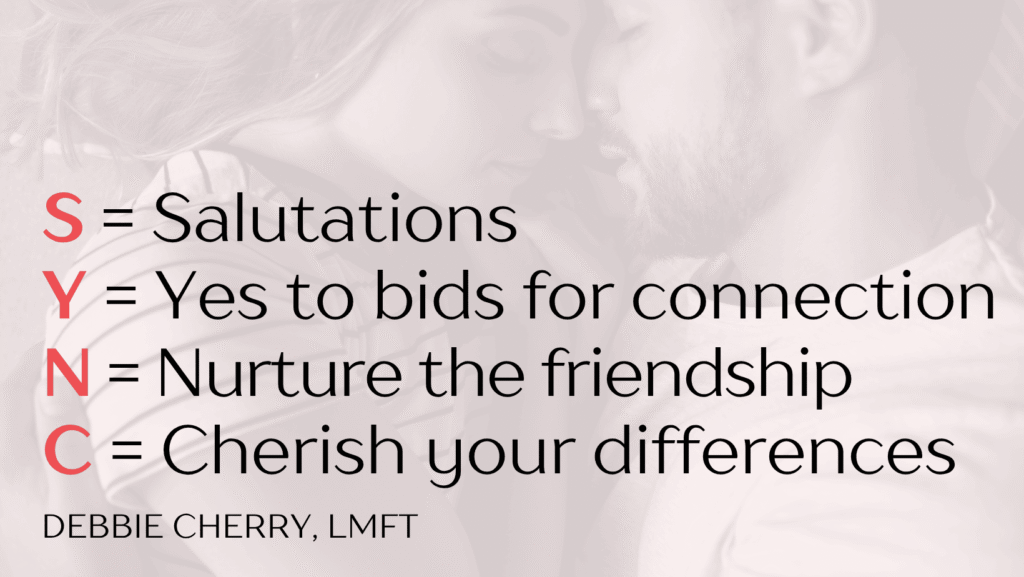
If you want to keep the spark alive, it helps to focus on two habits from the SYNC Tool:
N = Nurture the friendship
C = Cherish your differences
These two habits help couples move beyond logistics and back into connection, curiosity, appreciation, and play.
Improving Intimacy Starts with Nurturing the Friendship
One of the fastest ways couples grow distant is when they stop being curious about each other.
They start talking mainly about logistics.
Who is picking up the kids.
What time the appointment is.
What needs to get done.
What bill needs to be paid.
What happened at work.
Of course those conversations matter. But they are not enough to build closeness.
A relationship needs emotional conversation too. It needs room for both partners to keep unfolding. It needs space to talk about how life feels, what is changing, what is meaningful, what is hard, and what each person is becoming.
People are always changing.
Your partner is not the exact same person they were six months ago. Or two years ago. Or even last month. Their inner world keeps evolving. Their stress shifts. Their hopes and dreams change. Their needs become clearer. Their perspective expands.
So one of the most powerful ways to grow closer is simply making time to ask real questions again.
Better Questions Help Keep the Spark Alive
When couples want to reconnect, one of the best places to start is with the kinds of questions they ask.
Many couples fall into closed questions without realizing it:
Did you have a good day?
Are you okay?
Did that go well?
Do you want to go?
Is something wrong?
These questions are not bad.
They are just limited.
They often invite short answers, not deeper connection.
If you want to keep the spark alive, ask questions that open a door instead of closing one.
This fits with Gottman’s Love Maps research, which emphasizes how important it is for couples to keep knowing each other’s inner world — their stresses, hopes, worries, preferences, and changing experiences.
Love Maps are not something you build once and finish.
They stay strong when couples keep asking thoughtful, open-ended questions and keep updating their understanding of each other over time.

Open-Ended Questions Help Partners Open Up
Open-ended questions that begin with what and how tend to work especially well because they invi
te reflection, emotion, and depth without sounding sharp or interrogating.
For example:
- What felt most important about your day today?
- How are you feeling about life lately?
- What has been taking up the most space in your mind?
- What has felt energizing for you lately?
- How can I help you feel more supported this week?
- What is something you wish I understood better right now?
- What are you needing more of these days?
These kinds of questions do more than create conversation.
They communicate:
I still want to know you.
I still want to understand you.
I know there is more to you than what I assume.
That is one of the deepest forms of intimacy.
Why Asking “Why” Can Backfire
Even though “why” is technically open-ended, it often lands differently in close relationships.
Questions like:
Why did you do that?
Why are you mad?
Why are you being quiet?
Why do you always think that?
…can sound blaming, critical, or defensive, even when that is not the intention.
That is why softer questions that start with how or what often work better.
Instead of:
“Why are you upset?”
Try:
“What is feeling especially hard right now?”
“How can I understand what is going on better?”
Instead of:
“Why did you do that?”
Try:
“What was going on for you in that moment?”
“How did that make sense from your perspective?”
This shift matters because emotional safety helps people open up.
And emotional openness is one of the core intimacy building practices that helps couples reconnect.
How Curiosity Builds Emotional Intimacy
Curiosity is not just polite conversation. It is one of the most important ways couples nurture friendship.
When your partner feels that you still want to know them, something softens. They feel more visible. Less alone. More emotionally met.
This matters because friendship is not separate from romance. In many long-term relationships, friendship is what protects and renews the spark.
The more couples feel emotionally interested in each other, the more likely they are to feel connected, affectionate, playful, and close.
If couples stop asking, they often start assuming.
And assumption is one of the quietest ways intimacy fades.
When you assume you already know everything, you stop discovering your partner. When you stop discovering your partner, the relationship can start to feel emotionally flat. When the relationship feels flat, the spark can feel far away.
That is why daily curiosity is one of the most practical ways to keep the spark alive.
Intimacy Building Practices Also Need Tension
The spark is not only about similarity.
It often comes from difference.
The person who slows you down.
The person who stretches you.
The person who sees life differently than you do.
The person who brings out qualities in you that you want more access to.
In the beginning, those differences often feel attractive, adorable, or inspiring.
Later, those same differences can become sources of frustration.
That is normal.
The qualities that once felt exciting can become harder to appreciate when life gets stressful.
Spontaneity can start to look irresponsible.
Structure can start to feel controlling.
Drive can start to feel intense.
Ease can start to look like not caring.
Playfulness can start to feel distracting.
Practicality can start to feel boring.
But often, the core quality has not changed.
The meaning you are assigning to it has.
Cherishing your differences means looking for the strength inside the trait that frustrates you.
This difference is not just a source of friction.
It may also be part of what keeps us alive, balanced, and growing.

Difference Can Become Playfulness and Possibility
Your differences do not have to become liabilities.
They can become part of your shared strength again when you treat them with curiosity, fondness, and appreciation instead of suspicion.
When couples stay curious, their differences stay interesting.
When couples create small moments of delight, their differences can feel energizing again.
When couples stop assuming and keep exploring each other, the relationship stays more dynamic.
The spark often fades when couples stop seeing each other with fresh eyes.
It grows when they return to curiosity, appreciation, playfulness, and discovery.
If you want to keep the spark alive, do not underestimate the power of a small gesture.
Spark is often less about intensity and more about energy.
It is the feeling of being pleasantly surprised.
The feeling of being thought of.
The feeling of being enjoyed.
The feeling that there is still warmth, playfulness, and possibility here.
Cherishing your differences can happen in very small ways:
- sending a playful text in the middle of the day
- bringing home their favorite drink or snack
- sharing a memory that still makes you smile
- clearing their side of the bed and inviting them in
- putting on their favorite music before they get home
- suggesting a short walk after dinner
- leaving a note where they will find it
- making them laugh on purpose
- taking over a task quietly so they can rest
- complimenting them in front of someone else
- offer a spontaneous hug, kiss, or affectionate touch
- planning a tiny surprise with no special occasion attached
These gestures may seem simple, but they shift the emotional atmosphere of a relationship.
They interrupt dullness.
They bring in warmth.
They create a sense of movement and life.
And that is part of what people mean when they say they want the spark back.
Simple Phrases That Rekindle Attraction
If you cannot think of a gesture, you can still create spark with your words.
One of the simplest ways to reintroduce warmth, attraction, and delight is to say:
“I love it when…”
Then name something your partner does that makes you feel connected, drawn in, or more alive with them.
Try:
I love it when you laugh like that.
I love it when you get excited about something you care about.
I love it when we slow down and just enjoy each other.
I love it when you touch me like that.
I love it when your humor lightens the mood.
I love it when your steadiness helps me feel safe.
I love it when your creativity opens up new possibilities.
I love it when your structure helps our life feel calmer.
I love it when your playfulness pulls me out of stress.
These phrases help your partner feel seen not only for what they do, but for who they are.
That is what cherishing does.
It turns difference back into appreciation.
✅ Improve your connection in small moments. Download the free Intimacy Practices PDF for simple open-ended questions to nurture the friendship and easy ways to cherish your differences daily (no email needed).
Daily Intimacy Building Practices Matter More Than Occasional Big Efforts
One big date night can be lovely.
A weekend away can be wonderful.
But the emotional tone of a relationship is usually shaped more by daily habits than occasional events.
That is why the most effective intimacy practices are often small enough to repeat consistently.
A few meaningful minutes matter.
One thoughtful question matters.
One sweet gesture matters.
One playful moment matters.
One pause to really notice each other matters.
One “I love it when…” matters.
These moments add up.
They help couples feel like more than co-managers of a household.
They help partners feel chosen again.
They help the relationship feel less mechanical and more alive.
And the more these moments happen, the more couples often want to create them.
Warmth tends to invite warmth.
Curiosity tends to invite openness.
Delight tends to invite delight in return.
That positive cycle is one of the most powerful ways to keep the spark alive over time.
keep connecting,
Debbie Cherry, LMFT
WANT TO FEEL THE SPARK AGAIN?
💝 Grab the free Connected Communication Toolkit with simple, science-backed habits to deepen emotional and physical intimacy in everyday moments.
📅 Book a free consultation or session to reconnect, rebuild closeness, and bring back the spark—without pressure or blame.
Next Step ➡️ Boost Closeness and Affection with These Couples Conversation Starters
💬 FAQs About Keeping the Spark Alive
What are intimacy-building practices in a relationship?
Intimacy-building practices in a relationship are the small, meaningful ways couples stay emotionally and physically connected over time. They include communication, physical affection, eye contact, spending time together, support, shared experience, sex, desire, and simple moments that help both you and one partner feel acknowledged instead of taken for granted. In a good relationship, these practices may look like holding hands, pausing for a deep breath before reacting, asking better questions, noticing what matters, and making time for the most important things even in the middle of children, family, work, and all the things life brings. These are the habits that help keep a relationship healthy, intimate, and alive in each other’s eyes.
How do you keep the spark alive in a long-term relationship?
To keep the spark alive in a long-term relationship, couples usually need more than love alone. They need small daily habits that help the relationship stay healthy and emotionally engaged. That might mean physical affection, eye contact, communication, a surprise date, a new shared experience, or simply spending time together with more intention. In long-term couples, one important thing is to resist the tendency to assume your partner expects you already know everything or that you can forget to nurture the relationship for a while without consequence. A healthy relationship stays alive when both you and your partner keep showing curiosity, support, desire, and appreciation, instead of taking each other for granted. Sometimes the aim is not to do all the things, but to lead with one simple act that helps your husband, wife, or partner feel loved, seen, and intimate again.
Why do couples lose the spark?
Couples lose the spark for many normal reasons. Life gets crowded with children, family responsibilities, loved ones, work, stress, and the pressure of managing all the things. Communication gets reduced to logistics. Physical affection may drop off. Sex and desire can feel harder to access. One partner may feel taken for granted, while the other partner expects the relationship to stay strong without much attention. Over time, couples may forget the most important things that keep a relationship alive, such as eye contact, affection, support, fun, novelty, and shared experience. In others’ eyes, a couple may still look healthy, but behind closed doors the relationship can start to feel flat. That does not always mean something is broken. It often means couples need to break routine, acknowledge the distance, and reconnect on deeper levels.
Can small daily habits really improve intimacy?
Yes. Small daily habits can absolutely improve intimacy because they shape the emotional rhythm of a relationship. A deep breath before responding, eye contact when your partner is talking, holding hands, a little physical affection, better communication, or a few extra minutes of spending time together can lead to deeper levels of closeness and trust. For long-term couples, these moments matter because they help both you and one partner feel supported, acknowledged, and emotionally safe. A healthy relationship is often strengthened less by one huge gesture and more by repeated small moments of warmth, care, and connection. Those habits can support sex, desire, passion, and emotional intimacy over time, especially when couples stop taking each other for granted.
What if we feel more like friends than romantic partners?
If you feel more like friends than romantic partners, that does not mean the relationship is doomed. Friendship is actually one of the strongest resources in a good relationship, but couples also need intimacy, desire, and some sense of aliveness to keep the relationship healthy. Sometimes long-term couples start functioning more like teammates or family than romantic partners, especially when children, stress, and routines take over. The path back often includes more physical affection, eye contact, communication, support, and intentional spending time together that is not only about responsibilities. Friends holding hands, laughing, sharing a surprise date, or creating a new shared experience can help a couple feel intimate again. Passion often grows when both you and your partner stop assuming romance will take care of itself and instead aim to nurture it in small, consistent ways.
Can sex and desire come back after a disconnected season?
Yes, sex and desire can come back after a disconnected season. For many long-term couples, desire fades not because love is gone, but because stress, distance, resentment, self-confidence struggles, family pressure, or lack of communication have made it harder to feel open and intimate. One partner may want more sex, while the other needs more support, affection, or emotional safety first. It helps to acknowledge what has been happening instead of pretending it does not matter. Rebuilding often starts with the most important things that help a relationship feel alive again: physical affection, eye contact, spending time together, honest communication, and small shared experiences that create warmth and connection. When couples stop taking each other for granted and start turning back toward each other, passion and desire often have a much better chance to lead the way back in.
📚 Intimacy Building Activities References & Resources
How Love Maps Can Help Rewrite Your Relationship Story offers a clear, accessible explanation of Love Maps and why couples stay closer when they keep updating their understanding of each other’s inner world over time.
The Seven Principles for Making Marriage Work is one of the most widely known introductions to John Gottman’s relationship research, especially around friendship, emotional attunement, and the small daily interactions that strengthen long-term love.
The Power of Habit offers a practical framework for understanding how small repeated behaviors gradually become patterns that shape everyday life. It fits beautifully with the idea that intimacy is often built through consistent daily practices rather than occasional grand gestures.
Harnessing the Power of Habits provides a more science-based look at how habits form and why repeated actions are so powerful in everyday life. It supports the idea that tiny relational choices, repeated over time, can change the tone of a relationship.
Active Listening: The Complete Guide is a helpful resource on listening skills, including the value of open-ended questions for creating more reflection, responsiveness, and emotional depth in conversation.
Do People Know What They Want: A Similar or Complementary Partner? offers a more nuanced look at attraction and compatibility, showing that people often think in terms of complementary traits even though real relationship preferences are more complex. It works well for your point that differences can feel magnetic and energizing, especially early on.
Deepen Your Bond in Minutes A Day with SYNC
SYNC = Salutations + Yes • Nurture + Cherish
S = Start with warm salutations
Y = Yes to bids for connection
N = Nurture the friendship
C = Cherish your differences
If you are wondering how to quickly feel closer… couples therapy, marriage counseling, or intimacy & sex therapy can help you figure out what is actually happening underneath the conflict and whether the relationship has enough trust, respect, and shared vision to move forward well.