
Conflict Isn’t the Problem. Survival Mode Is.
One of you gets triggered. The other reacts. Suddenly you’re no longer talking about what just happened—you’re arguing about what happened last month, what always happens, who started it, who does more, who cares less, and why nothing is ever going to change.
When your nervous system shifts into protection mode, your brain starts doing exactly what it was designed to do: look for danger, remember previous threats, predict what might go wrong next, and protect you from getting hurt.
That’s useful when you’re facing an actual threat. It’s not always so useful when you’re trying to work something out with the person you love.
When couples are triggered, several predictable patterns can take over:
- You pull old hurts and narratives into the present.
- You assume negative intentions.
- You focus on what the other person is doing wrong.
- You defend yourself and blame each other.
- You notice and remember the negative more than the positive.
And without realizing it, you keep creating more evidence for the exact story you already believe.
They never listen.
I’m always the one who has to fix everything.
They don’t care.
Nothing ever changes.
The PART tool is a practical couples conflict resolution method because it doesn’t argue with logic — it calms the nervous system first, then gently corrects the brain’s biased shortcuts that get in the way of connection.
Think of PART as the “Stop, Drop, and Roll” for Relationships.
PART = Present • Assume the Best • Responsibility • Thankful
You don’t have to wait for your partner to go first.
You can start by doing your PART.
After working with thousands of couples, I’ve seen these four evidence-based practices transform reactive fights into emotional repair.
Research from the Gottmans found that stable couples maintain roughly a 5-to-1 ratio of positive to negative interactions during conflict. That’s not easy to do when you’re triggered.
The PART practice gives you a simple framework for keeping negative reactive thought patterns in check while intentionally adding more of the positive—like being present, assuming the best, taking responsibility, and expressing gratitude—that helps protect connection even in difficult moments.
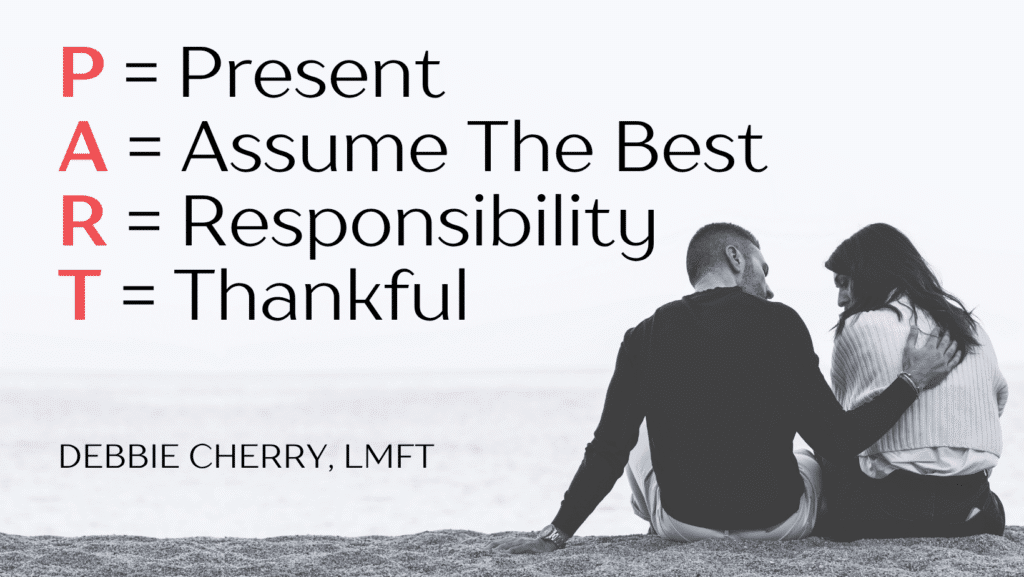
P = Be Present
When you’re triggered, your mind rarely stays in the present. Instead, it starts gathering evidence from the past.
“Here we go again.”
“This is exactly what they always do.”
“Remember what happened last time?”
Or it races into the future.
“What if this never changes?”
“What does this mean about our relationship?”
“I need to protect myself.”
Now you’re no longer responding only to what is happening in this particular moment. You’re responding to the past, the future, old wounds, old beliefs, fears, predictions, and everything your brain thinks this moment might mean.
Then confirmation bias can take over.
Once your brain has a story—They don’t care about me, for example—it naturally starts noticing everything that supports that conclusion while overlooking information that doesn’t. The more you repeat the story, the more true it feels.
So the first PART Practice is simple:
Come back to what is actually happening right now.
Ground yourself in the moment.
Look at the person in front of you instead of the version of them created by every argument you’ve ever had.
Ask yourself:
What is actually happening in this moment?
What do I know versus what am I assuming?
What do I want to happen next?
How do I want to show up right now?
Sometimes being present looks very practical. Take one slow breath before speaking. Notice your feet on the ground. Relax your jaw and shoulders. Lower your voice. Let your partner finish their sentence. Put your phone down. Make eye contact.
Say, “Give me a second to think.”
Remind yourself:
“This is this moment… not every moment we’ve ever had.”
You cannot change the past during an argument.
You cannot control the future.
But you can influence what happens in the next thirty seconds.
Being present helps you stop automatically repeating an old relationship pattern long enough to create a NEW one.
A = Assume the Best
When people feel threatened, hurt, or overwhelmed, we tend to develop an interesting double standard. We explain our own behavior through circumstances.
“I snapped because I’m exhausted.”
“I forgot because I have a million things going on.”
“I shut down because I felt overwhelmed.”
But we explain our partner’s behavior through character.
“They snapped because they’re selfish.”
“They forgot because I’m not important to them.”
“They shut down because they don’t care.”
This is related to what psychologists call attribution bias.
We often give ourselves the benefit of the doubt while assigning more negative motives to someone else. And when your nervous system is already in protection mode, that tendency can become even stronger.
Suddenly you aren’t responding only to what your partner did. You’re responding to what you believe their behavior says about who they are and how much they care about you.
So intentionally lean the other way.
Assume the best reasonable explanation before automatically assuming the worst.
Tell yourself:
“They may be overwhelmed, not trying to hurt me.”
“They’re having a hard moment.”
“We both want this relationship to work.”
“They care about me, even if this isn’t coming out well.”
“This might be stress, not disrespect.”
“We’re on the same team.”
“They’re trying, even if they’re not doing it perfectly.”
Assuming the best doesn’t mean ignoring reality. It doesn’t mean excusing cruelty, abuse, dishonesty, or repeated harmful behavior. And it doesn’t mean convincing yourself that something is okay when it isn’t.
It simply means not assigning the worst possible motive to your partner before you actually know what is happening.
There is a huge emotional difference between:
“You forgot because you don’t care about me.”
and
“You forgot. I’m hurt, and I want to understand what happened.”
One creates a courtroom. The other creates a connection.
R = Take Responsibility
When conflict escalates, couples often get caught in a power struggle.
“Why should I change when you’re the one who started it?”
“I’ll apologize when you apologize.”
“I’m not doing anything differently until you admit what you did.”
Now both people are waiting for the other person to go first. Both people are defending themselves. Both people are keeping score. Both people are trying not to lose. And the relationship loses.
This is where couples can get caught in what is sometimes described as the Drama Triangle—moving between blaming, rescuing, attacking, defending, or feeling powerless. The exact roles may change from argument to argument. The pattern stays the same. The focus remains on what the other person is doing wrong.
The way out is to ask a different question:
What is mine to do right now?
Then do it.
Take responsibility for your PART.
Sometimes that means saying something out loud.
“I’m sorry I interrupted you.”
“You’re right. My tone wasn’t okay.”
“I can see how that hurt you.”
“I should have told you sooner.”
“I’m going to slow down and listen.”
“I could have handled that differently.”
Other times, responsibility doesn’t require an announcement. Just change what you’re doing.
Stop interrupting. Lower your voice. Offer to help. Put your phone away. Listen instead of preparing your defense. Ask a better question. Take a breath. Reach for their hand. Do one thing that makes the interaction better instead of worse.
Do your PART.
Taking responsibility does not mean taking responsibility for everything. It doesn’t mean accepting blame that isn’t yours. It doesn’t mean tolerating mistreatment.
It means taking ownership of the part you actually control.
Your tone. Your words. Your behavior. Your repair. Your next move.
You have much more power to change a relationship pattern when you stop waiting for someone else to change first.
T = Be Thankful
When relationships become stressed, your brain becomes very efficient at noticing what is wrong.
The forgotten task. The irritating habit. The sharp tone. The thing they didn’t do. The disappointment from last week. The argument from three years ago.
This is part of the brain’s natural negativity bias.
Negative experiences tend to grab more of our attention and stay with us more strongly than positive ones.
That’s useful from a survival perspective.
Your brain is more interested in remembering where you encountered danger than where everything went perfectly fine.
But in a long-term relationship, this can create a serious imbalance.
You can slowly build a mental file containing hundreds of examples of what your partner does wrong while barely registering the dozens of things they do right every day.
So deliberately lean in the other direction.
Find something you are genuinely thankful for.
Think it. Actually feel it.
Better yet, say it.
“Thank you for telling me how you feel.”
“Thank you for listening.”
“Thank you for trying.”
“Thank you for showing up for our family.”
“Thank you for staying in this conversation with me.”
“Thank you for wanting to work this out.”
Sometimes you can even remind yourself of the other side of a quality that is currently driving you crazy.
The stubborn person who won’t let something go may also be persistent and loyal.
The overly sensitive partner may also be incredibly empathetic.
The forgetful person may also be spontaneous and creative.
The person who takes forever to make a decision may also be thoughtful and careful.
Most of the qualities we love about people have another side that can drive us crazy under different circumstances.
You don’t have to pretend the frustrating part isn’t frustrating. You simply remember that your partner is a whole person—not just the collection of things bothering you right now.
Gratitude helps counter the brain’s natural tendency to stack the negatives.
It can soften defensiveness. It can lower the emotional temperature.
It can remind both nervous systems:
We are still okay.
There is still good here.
We’re still on the same team.
Healthy relationships aren’t defined by how little couples fight — they’re defined by how effectively partners practice couples conflict resolution when disagreements happen to reconnect quickly. The PART tool gives you a way to do exactly that.
📸 Snap a screenshot of the PART Tool to use when you need it most.
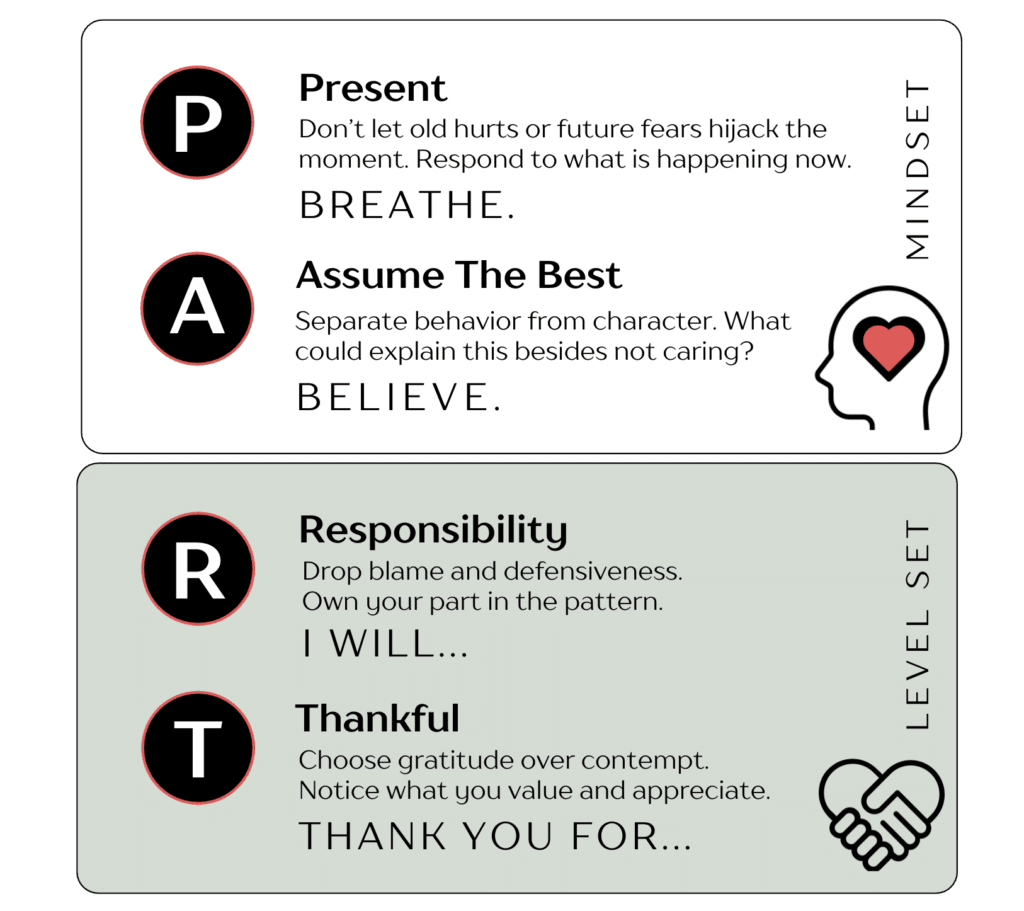
✅ Navigate couples conflict with calm and connection. Download the free PART Tool — instant access, no email required.
Doing Your PART Is Not Being a Doormat
Sometimes people hear these practices and immediately think:
“Why should I have to do this when they’re the one behaving badly?”
“Why am I always the one who has to be mature?”
“Doesn’t this mean I’m just letting them get away with it?”
No.
PART isn’t about surrendering your needs.
It isn’t about avoiding difficult conversations.
And it isn’t about making yourself smaller to keep someone else comfortable.
It’s about recognizing that when you’re triggered, your brain naturally pulls you toward behaviors that often create MORE of what you don’t want. Practicing PART gives you a way out of that reflex.
You aren’t ignoring the problem.
You’re creating a better environment in which to actually address it.
Sometimes the strongest thing you can do in a conflict isn’t fight harder.
It’s refuse to keep repeating the same pattern.
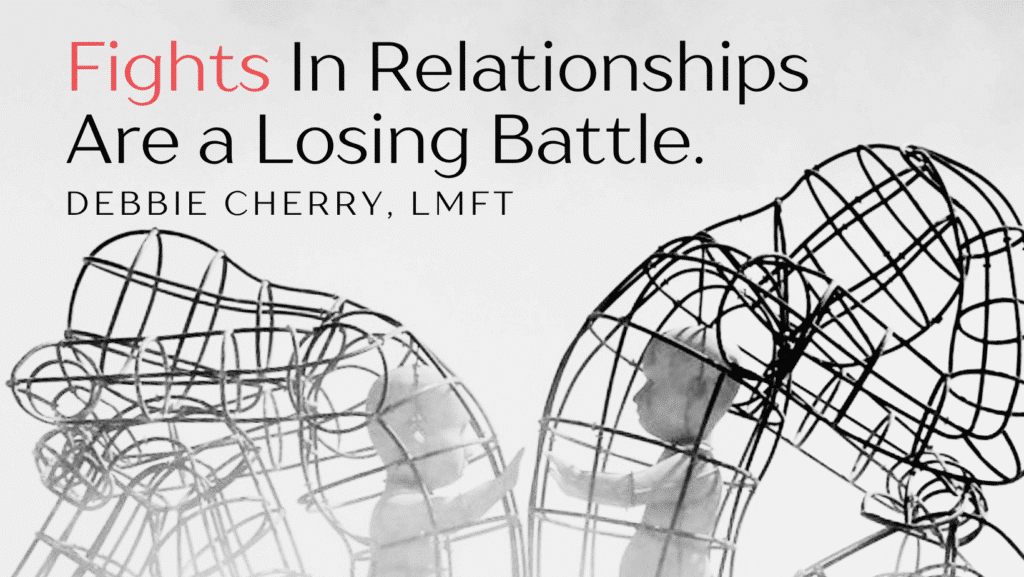
The Key to Emotional Safety During Conflict
Feeling connected isn’t a luxury — it’s a biological need.
Our brains and nervous systems are deeply affected by our most important relationships.
When something feels wrong between you and your partner, even a relatively small interaction can sometimes register as a threat.
Are we okay?
Do you still care about me?
Can I trust you?
Am I alone in this?
When those deeper fears and defenses become activated, both people may shift from connection into protection.
One criticizes. The other withdraws. One gets louder. The other becomes defensive. One pushes harder. The other shuts down further.
Now each person’s protection strategy becomes the other person’s trigger.
Trying to communicate effectively while both nervous systems are overwhelmed is a little like trying to have a thoughtful conversation while the room is on fire.
PART helps you lower the flames first.
Then you have a much better chance of actually talking about what matters.
The Real Goal Is Repair, Not Winning
Gottman’s decades of research suggest that nearly 70% of relationship problems are perpetual—even among happy couples.
What predicts success is not agreement on every issue. It is the ability to repair. You do not have to prove your entire case or resolve everything in one conversation.
In most relationship arguments, when one partner wins and the other loses, the relationship still loses.
Sometimes the fastest path forward is repairing before resolving, understanding before correcting, and regulating before communicating.
Conflict is a natural part of close relationships.
How you handle it determines the success of your relationship.
Do Your PART
The next time you notice an argument starting to spiral, you don’t need to remember twenty communication techniques.
Remember four things:
P — Be Present.
Come back to what is actually happening right now.
A — Assume the Best.
Don’t automatically assign the worst possible motive.
R — Take Responsibility.
Own your part and do one thing that makes the interaction better.
T — Be Thankful.
Remember and express something genuinely good.
You can’t always control what your partner does next.
But you can change what you bring into the moment.
And sometimes one person stepping out of the old pattern is enough to give both people a chance to find a new one.
Do your PART.
You may be surprised how quickly one different move can change what happens next.
Keep connecting,
Debbie Cherry, LMFT
WANT TO STOP RECURRING FIGHTS?
💝 Grab the free Connected Communication Toolkit, filled with practical tools to help you talk, listen, repair, and grow closer.
📅 Book a consultation or session to hit the reset button, understand the cycle underneath your recurring conflicts, and find a clearer path forward.
Next Step ➡️ Learn What Habits Matter Most for Successful Relationships & Avoid Fights Before They Start with the SWOT Analysis Couples Activity.

💬 FAQs About Repairing Couples Conflict Fast
1. Why do we keep fighting about the same things?
Many recurring arguments aren’t really about the surface issue.
Household chores, money, parenting, sex, schedules, phones, in-laws, or being late may trigger deeper feelings about being valued, respected, supported, prioritized, or understood.
Once the negative cycle starts, couples often repeat familiar protective behaviors.
The goal is to recognize the pattern earlier and make a different move before the argument gains momentum.
2. How do we stop small disagreements from becoming huge fights?
Catch the cycle earlier.
Pause.
Come back to the present.
Notice your body, tone, and assumptions.
Try not to assign negative motives to your partner.
Take responsibility for one thing you can do differently.
A small change early in an argument is much easier than trying to repair things after both people are completely overwhelmed.
3. What’s the fastest way to resolve conflict in a relationship?
Often the fastest route isn’t immediately solving the issue.
It’s reducing the threat level first.
When both partners feel attacked or defensive, problem-solving becomes much harder.
Focus first on regulating, softening, understanding, and repairing.
Then return to the actual problem.
Connection before correction often gets you to a solution faster.
4. Does assuming the best mean ignoring bad behavior?
No.
Assuming the best means not automatically deciding that your partner’s mistake or frustrating behavior proves they don’t care about you or intended to hurt you.
You can assume good intent and still address harmful impact.
For example:
“I don’t think you meant to hurt me, but that really did hurt.”
Both things can be true.
5. What if I’m always the one taking responsibility?
Healthy responsibility needs to exist on both sides of a relationship.
Doing your PART doesn’t mean carrying the entire emotional load indefinitely.
If one partner consistently refuses accountability, dismisses the other’s needs, or engages in harmful behavior without meaningful repair, expert guidance may be necessary to help change the pattern—or, in some cases, separation may need to be considered.
PART is designed to interrupt normal negative conflict cycles—not excuse ongoing mistreatment.
6. How can we communicate better during arguments?
Slow everything down.
Use a calmer tone.
Speak about your own feelings and experience instead of attacking your partner’s character.
Listen long enough to actually understand their perspective.
Be curious about what is underneath their reaction.
And remember that your partner’s nervous system is responding to you just as yours is responding to them.
Communication is not just about the words you say.
It’s also about what the other person experiences while you’re saying them.
7. When should couples consider professional help?
Consider couples therapy or relationship coaching when you repeatedly have the same arguments without resolution, feel increasingly disconnected, struggle to repair after conflict, or find that conversations quickly become hostile, defensive, or shut down.
Professional support can help you identify the cycle underneath the arguments and learn specific strategies for changing it.
You don’t have to wait until a relationship is in crisis to get help.
Sometimes learning a different way to handle conflict early prevents years of resentment later.
Why the PART Practices Work
The PART Practices are simple, but they are informed by several overlapping areas of relationship psychology, attachment science, neuroscience, and couples therapy.
They all point toward a similar idea:
When people feel emotionally threatened, they protect themselves.
And many of the behaviors we call “communication problems” are actually protection strategies happening between two activated nervous systems.
The PART Practices help interrupt those strategies.
Present: Regulation and Mindfulness
When you bring yourself back to the present, you create space between what you feel and what you do next.
Mindfulness and somatic approaches emphasize noticing what is happening in your body and slowing automatic reactions.
You aren’t trying to stop having emotions.
You’re giving yourself enough space to choose how to respond to them.
Assume the Best: Countering Attribution Bias
When we’re hurt, we’re more likely to interpret ambiguous behavior negatively.
Choosing a more generous interpretation helps prevent assumptions from becoming accusations.
Instead of deciding you already know your partner’s motives, you leave room for curiosity.
Take Responsibility: Stepping Out of the Drama Triangle
Blame can make both partners feel powerless.
Responsibility gives you agency.
You stop waiting for someone else to fix everything and identify what is actually within your control.
This doesn’t remove accountability from your partner.
It puts you back in charge of your own contribution to the interaction.
Thankful: Countering Negativity Bias
Human beings are naturally wired to notice threats and negative experiences.
Intentionally practicing gratitude and appreciation helps rebalance attention.
Over time, regularly noticing what is working can protect fondness and friendship from getting buried underneath daily frustrations.
The Relationship Approaches Behind PART
My approach to couples work draws from several evidence-based and research-informed models.
Attachment Theory
Attachment science suggests that human beings are wired to seek connection, responsiveness, and safety from important attachment figures.
When partners feel ignored, rejected, criticized, or misunderstood, the nervous system may interpret the moment as a threat to connection.
Some people respond by pursuing harder.
Others withdraw.
Some criticize.
Some shut down.
PART helps partners interrupt those protective reactions and respond more intentionally.
Emotionally Focused Therapy
Emotionally Focused Therapy focuses heavily on the negative cycle that develops between partners.
Instead of viewing one person as the problem, the cycle itself becomes the problem.
PART supports this idea by helping each person recognize the moment when the cycle is pulling them in—and make a different move.
PACT and Interpersonal Neurobiology
Approaches grounded in neuroscience and attachment emphasize how quickly our brains and bodies react to our partners.
Tone of voice.
Facial expressions.
Body language.
A pause.
A sigh.
A look.
Our nervous systems are constantly reading each other.
PART encourages partners to slow those reactions and become more intentional about the signals they send.
Gottman Method Research
Gottman-informed couples work emphasizes behaviors including repair attempts, soft start-ups, fondness and admiration, turning toward bids for connection, and reducing destructive patterns such as criticism, contempt, defensiveness, and stonewalling.
PART supports many of the same goals by helping couples move away from automatic negative responses and toward repair.
Mindfulness and Somatic Approaches
Mindfulness and body-based practices help people notice physiological activation before it completely takes over.
Sometimes the most important communication skill is noticing:
My heart is racing.
My jaw is tight.
I’m about to say something I’ll regret.
That awareness gives you the opportunity to return to the present and choose what happens next.
📚 Couples Conflict References & Resources
- Escaping the Drama Triangle: Strategies for Successful Relationships
This article explores the drama triangle—the repeating cycle of victim, rescuer, and persecutor—and how it undermines emotional safety and connection. It shows how one partner may carry more emotional weight in couples work and how avoiding conflict only delays healing to a later date. The piece reminds readers that feeling angry or encountering hurtful things is a natural part of healthy relationships, and that couples therapy can help partners step out of blame and into teamwork. - How to Create Emotional Safety in Your Relationship
This resource offers grounded, practical steps for cultivating safety and trust during conflict. It normalizes the fact that anger and defensiveness are a natural part of intimacy, while showing how self-regulation and empathy create healthy relationships. Ideal for partners doing couples work or simply learning to stay connected when emotions rise. - Gottman Relationship Research Overview
Decades of relationship research demonstrate that about 69 percent of relationship conflicts are perpetual—rooted in personality traits, underlying issues, and normal differences between partners. The findings affirm that conflict is a normal part of healthy relationships and emphasize the importance of not avoiding conflict or letting things linger. Instead, good communication and win-win solutions help couples move forward so they can grow stronger.
NEXT STEP ➡️ Avoid Fights Before They Start & See What Habits Matter Most for Successful Relationships with the SWOT Analysis Couples Activity.